
November is one of the most productive months of the year for vegetable gardening in Zone 9.
In this guide, you’ll find everything you need for November in Zone 9:
• The full guide below — what to plant, how to plant it, and what to watch for (including downloadable pdf)
• A quick checklist – at the bottom, so you don’t miss anything (including downloadable pdf)
While gardeners in colder climates are preparing to put their gardens to bed for winter, Zone 9 gardeners are enjoying one of the best planting seasons of the year.

The intense summer heat has usually faded, nights are getting cooler, and many vegetables that struggled during September and October can finally grow under more favorable conditions.
November is an excellent time to plant garlic, strawberries, cabbage, lettuce, kale, spinach, carrots, radishes, peas, onions, and many other cool-season crops.
For gardeners who started their fall gardens in September or October, November is also an important month for maintaining established plants, planting additional crops, and preparing for winter harvests.
However, November growing conditions can vary significantly across Zone 9.
A gardener in Central Florida may still experience afternoon temperatures in the 80s, while a gardener in inland California, Arizona, or North Texas may already be dealing with occasional frost.
USDA hardiness zones describe average annual extreme minimum temperatures, not complete growing-season conditions.
Use this guide as your November planting starting point, then adjust based on your local weather, soil temperature, and expected frost dates.
What Can You Plant in November in Zone 9?
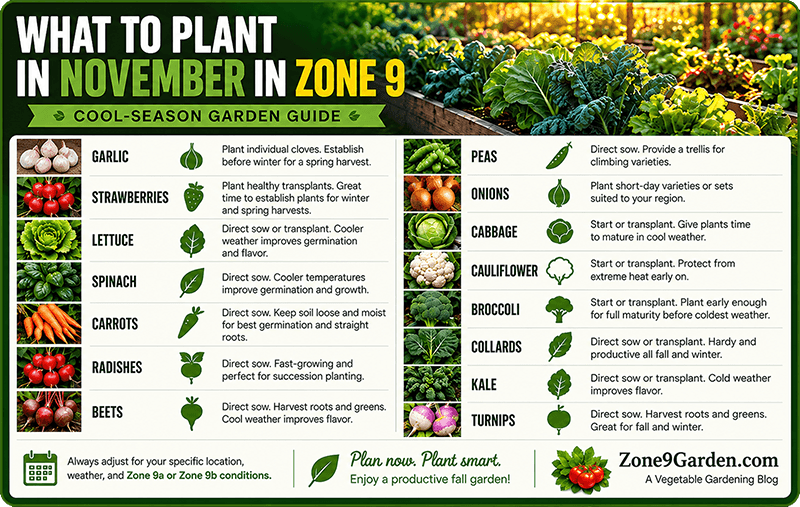
(Downloadable PDF – Click Here)
November is primarily a cool-season planting month, but it also introduces several crops that benefit from being planted as winter approaches.
Garlic, onions, strawberries, and peas deserve particular attention this month.
Here’s a quick starting point for what to plant in November.
| Crop | November Strategy |
|---|---|
| Beets | Direct sow |
| Broccoli | Transplant established seedlings |
| Cabbage | Transplant |
| Carrots | Direct sow |
| Cauliflower | Transplant where temperatures are suitable |
| Collards | Direct sow or transplant |
| Garlic | Plant individual cloves |
| Kale | Direct sow or transplant |
| Lettuce | Direct sow or transplant |
| Onions | Plant short-day varieties or sets suited to your region |
| Peas | Direct sow |
| Radishes | Direct sow |
| Spinach | Direct sow |
| Strawberries | Plant healthy transplants |
| Turnips | Direct sow |
These recommendations are not universal planting dates.
Gardeners in warmer Zone 9b locations may have a longer planting window, while gardeners in cooler areas should pay attention to frost forecasts and the time needed for crops to mature.
November is also an excellent month to continue succession planting vegetables that were started during October.
Instead of planting everything at once, spread your planting over several weeks to keep fresh vegetables coming throughout winter.
Garlic: One of November’s Most Important Crops
If you haven’t planted garlic yet, November is an excellent time to get started in many Zone 9 gardens.
Garlic is different from most vegetables because it is generally planted in fall and harvested the following spring or early summer.
Planting in November allows cloves to establish roots during cooler weather before producing vigorous growth as temperatures begin rising.
However, garlic variety selection is particularly important in Zone 9.
Many hardneck garlic varieties require a prolonged period of cold weather to develop properly. Since much of Zone 9 experiences relatively mild winters, softneck garlic is often a more dependable choice.
Look for varieties adapted to warm climates and short winters.
When planting garlic, separate the bulb into individual cloves shortly before planting.
Choose large, healthy cloves and plant them with the pointed end facing upward.
A typical planting depth is approximately 2 inches, with cloves spaced 4–6 inches apart.
Garlic grows best in well-drained soil and should receive consistent moisture without remaining waterlogged.
One important consideration for Zone 9 gardeners is chilling.
Some garlic varieties benefit from several weeks of refrigerated storage before planting in areas that do not experience enough natural winter cold. Requirements vary by variety, so choose locally adapted planting stock and follow supplier or regional Extension recommendations.
For additional information, visit our How to Grow Garlic in Zone 9 or Zone 9 Garlic Crop Profile.
Strawberries: Get Plants Established Before Winter
November is also an important strawberry planting month in many warmer Zone 9 locations.
Unlike gardeners in colder climates who often plant strawberries during spring, gardeners in much of the southeastern Zone 9 region can grow strawberries as a cool-season annual crop.
Planting in fall allows strawberry plants to establish strong root systems before producing fruit during winter and spring.
Healthy strawberry transplants are generally the easiest way to get started.
Choose plants with strong crowns, healthy leaves, and well-developed roots.
Strawberries prefer fertile, well-drained soil and plenty of sunlight.
Raised beds can be particularly useful in areas with poorly draining soil.
When transplanting, pay careful attention to crown depth.
The crown should remain at soil level. Planting too deeply can encourage rot, while planting too shallowly can expose the roots.
Mulch around the plants to reduce soil splashing, conserve moisture, and keep developing fruit away from direct contact with the soil.
Strawberry planting schedules vary substantially across Zone 9. November is especially useful in warm-winter production systems, while some California regions use earlier fall planting schedules.
Choose varieties recommended for your region rather than assuming every strawberry variety will perform equally well.
Lettuce and Leafy Greens
November is one of the easiest months to grow leafy greens in many Zone 9 gardens.
Lettuce, spinach, kale, collards, mustard greens, and Swiss chard all benefit from the cooler temperatures that arrive during late fall.
Lettuce is especially worth planting now.
During summer and early fall, high soil temperatures can interfere with germination, while hot weather encourages mature plants to bolt.
November’s shorter days and cooler nights often create much more favorable growing conditions.
Instead of planting an entire bed of lettuce at once, sow smaller amounts every week or two.
This provides a more manageable harvest and helps prevent all your lettuce from reaching maturity at the same time.
Spinach is another excellent November choice.
Gardeners who struggled with spinach during September or October may find that November provides the cooler conditions it needs.
Direct sow spinach into prepared soil and maintain consistent moisture during germination.
Kale and collards are particularly useful because they can provide repeated harvests.
Once plants become established, harvest mature outer leaves while allowing the growing center to continue producing.
These vegetables can remain productive well into winter in many Zone 9 gardens.
For more detailed planting information, read our How to Grow Lettuce in Zone 9 guide.
Broccoli, Cabbage, and Cauliflower
November is an important month for broccoli, cabbage, and cauliflower.
These vegetables belong to the brassica family and generally perform best during cooler weather.
If you transplanted them during September or October, your plants may now be developing substantial foliage or beginning to form heads.
Continue providing consistent moisture and inspect leaves regularly for caterpillars.
For gardeners who haven’t planted these crops yet, November can still be a suitable transplanting month, particularly in warmer Zone 9 locations.
Choose compact, healthy transplants with strong stems and avoid plants that have become severely root-bound.
Cabbage is particularly well suited to the cool-season garden.
With adequate spacing, fertile soil, and steady moisture, cabbage can develop firm heads during fall and winter.
Read our How to Grow Cabbage in Zone 9 guide for complete planting and care instructions.
Cauliflower requires a little more attention.
Unlike cabbage, cauliflower is particularly sensitive to interruptions in growth and temperature fluctuations.
Plants exposed to unfavorable conditions may produce small, loose, or poorly developed heads.
Our How to Grow Cauliflower in Zone 9 guide explains how to manage planting dates, watering, fertilization, and head development.
Broccoli also benefits from November’s cooler conditions.
For detailed growing instructions, visit our How to Grow Broccoli in Zone 9 guide.
Carrots and Beets
November is an excellent time to plant root vegetables.
Carrots and beets perform particularly well when temperatures are moderate and the soil remains consistently moist during germination.
Both crops should generally be direct sown into the garden rather than transplanted.
Carrots need loose, well-prepared soil to develop straight, healthy roots.
Remove rocks, compacted soil, large roots, and other obstructions before planting.
Sow carrot seeds shallowly and avoid allowing the soil surface to dry out while seeds are germinating.
Because carrot seeds are small and planted close to the surface, inconsistent moisture can significantly reduce germination.
Beets are another dependable November crop.
They provide two useful harvests: edible roots and tender greens.
Like carrots, beets need adequate spacing to develop properly.
Thin crowded seedlings early rather than allowing plants to compete for space.
For gardeners with limited growing space, both carrots and beets can be planted in raised beds or suitable containers.
November is also a good time to begin another planting if your October root vegetables are already growing.
Radishes and Turnips
If you’re looking for vegetables that can produce a harvest relatively quickly, radishes should be near the top of your November planting list.
Many common radish varieties mature in approximately 25–35 days under favorable conditions.
This makes them useful for filling small spaces between slower-growing vegetables.
Rather than planting an entire packet at once, sow a short row every week or two.
This provides a steady supply of fresh radishes instead of one large harvest.
Turnips are another excellent November vegetable.
They grow well during cool weather and can provide both edible roots and greens.
Direct sow turnips into prepared soil and thin seedlings as needed.
Turnips grown primarily for greens can be planted somewhat closer together than those intended to produce large roots.
Both vegetables benefit from consistent moisture and moderate temperatures.
If you’ve never grown turnips before, November is an excellent time to give them a try.
Peas: A Cool-Season Favorite
November is an excellent month to plant peas in many Zone 9 gardens.
Peas prefer cooler growing conditions and generally struggle during the intense heat of summer.
As November temperatures become more comfortable, garden peas, snow peas, and sugar snap peas become attractive options.
Direct sow peas into well-drained soil.
Many varieties benefit from a trellis or another support structure, particularly climbing types.
Install supports early so developing vines can begin climbing without becoming tangled.
Peas generally perform best when the soil remains evenly moist but not saturated.
Avoid excessive nitrogen fertilizer.
As legumes, peas can form beneficial relationships with nitrogen-fixing bacteria, although the effectiveness of this process depends on suitable soil conditions and the presence of compatible bacteria.
In cooler Zone 9a locations, pay attention to frost forecasts and select planting dates that allow young plants to establish before prolonged cold weather.
In warmer Zone 9b locations, November may mark the beginning of an extended pea-growing season.
Onions and Green Onions
November is also an important month for onions.
However, selecting the correct onion type is essential.
Onions form bulbs in response to day length, so varieties adapted to northern climates may not perform well in southern Zone 9 gardens.
Short-day onions are generally the best choice for many southern Zone 9 locations.
Popular examples include Granex-type onions and other varieties specifically recommended for short-day growing regions.
In some western Zone 9 locations, intermediate-day varieties may also be appropriate.
Plant onion transplants or sets according to local recommendations, keeping the growing point above the soil surface.
Avoid planting onions too deeply.
Green onions are another excellent November crop.
Unlike bulbing onions, green onions are harvested primarily for their tender leaves and immature stems.
They can be planted more densely and harvested as needed.
Both types benefit from fertile soil, adequate sunlight, and consistent moisture.
If you are unsure which onion varieties perform best in your area, check with your local Cooperative Extension office before purchasing planting stock.
Kale and Collards
Kale and collards deserve a permanent place in many Zone 9 winter gardens.
Both vegetables tolerate cool conditions and can continue producing leaves long after many warm-season crops have stopped growing.
November is a good month to establish new plants or maintain crops started earlier in fall.
Young kale and collard plants need consistent moisture and adequate space to develop.
Once established, they can provide repeated harvests throughout the cooler months.
Harvest larger outer leaves while leaving the center of the plant intact.
This allows the plant to continue producing new foliage.
Cool weather can also improve the flavor of some leafy greens, making November and December harvests particularly enjoyable.
Keep inspecting plants for cabbageworms, loopers, aphids, and other pests.
Even when temperatures become cooler, insects may remain active throughout much of Zone 9.
What About the Summer Garden?
November is when many Zone 9 gardeners begin making final decisions about their remaining summer vegetables.
Tomatoes, peppers, eggplant, and other warm-season crops may still be producing in the warmest parts of Zone 9.
However, cooler nights and shorter days can slow their growth.
The decision to remove a plant should depend on its health, productivity, and the weather expected in your area.
If a pepper plant is still producing healthy fruit, you may want to keep it.
If a tomato plant is severely diseased or producing very little, that space may be better used for cabbage, lettuce, carrots, or another cool-season crop.
Gardeners in frost-prone Zone 9a locations should be especially careful.
Tomatoes, peppers, and eggplant are vulnerable to freezing temperatures.
A single significant frost can end their growing season.
Gardeners in warmer Zone 9b locations may have more flexibility, but should still monitor local forecasts.
November is not necessarily the month when every summer vegetable must be removed.
It is the month when cool-season crops should become the primary focus of the garden.
November Herbs
November can be an excellent month for growing herbs that prefer mild temperatures.
Several herbs that struggled during summer become easier to manage as the weather cools.
Depending on your location, consider planting:
- Cilantro
- Parsley
- Dill
- Chives
- Rosemary
- Thyme
- Mint
Cilantro is particularly well suited to cooler weather.
High temperatures often cause cilantro to bolt quickly, but November conditions may allow plants to produce leaves for a longer period.
Parsley is another dependable cool-season herb.
It can be grown in garden beds or containers and harvested repeatedly once established.
Dill also performs well during cooler periods, although mature plants may need protection from strong winds.
Established rosemary and thyme can continue growing through mild winters, provided the soil drains properly.
Mint may also remain productive, although it is often best grown in containers to prevent unwanted spreading.
Basil is a different story.
Basil is sensitive to cold and may be damaged by frost.
If you’re growing basil outdoors, November is a good time to harvest remaining leaves before freezing weather arrives.
Keep Succession Planting
November is not a one-time planting opportunity.
One of the biggest advantages of gardening in Zone 9 is the ability to grow vegetables throughout much of fall and winter.
Instead of planting every seed at once, spread your planting across several weeks.
Succession planting works especially well with:
- Lettuce
- Radishes
- Carrots
- Beets
- Spinach
- Turnips
- Green onions
For example, you might plant one short row of radishes during the first week of November, another during the second week, and a third during the third week.
This helps extend your harvest and reduces the likelihood of having more vegetables ready at one time than you can use.
Lettuce can be planted in a similar way.
Sow small amounts every week or two rather than filling an entire bed at once.
Succession planting also provides some protection against unpredictable weather.
If one planting struggles because of heavy rain, an unexpected warm spell, or a cold snap, a later planting may perform better.
Prepare Your Garden for Winter
November is an excellent time to prepare your garden for the winter growing season.
Many cool-season vegetables are already established, but there is still plenty of maintenance to complete before December arrives.
Start by removing exhausted summer crops and weeds.
Do not leave heavily diseased plant material in garden beds where it may contribute to future pest and disease problems.
Inspect raised beds and containers for drainage issues.
Cooler temperatures and shorter days often mean soil remains wet longer than it did during summer.
Add finished compost where needed to improve soil structure and support healthy plant growth.
Avoid applying excessive fertilizer without considering existing soil fertility.
November is also a good time to inspect irrigation systems.
Repair leaking hoses, clogged emitters, and damaged fittings before winter weather arrives.
Other important November garden tasks include:
- Replenishing mulch around established plants.
- Checking broccoli, cabbage, and cauliflower for caterpillars.
- Preparing trellises for peas.
- Planting garlic before the preferred local window closes.
- Making room for additional leafy greens.
- Removing weeds before they produce seeds.
- Keeping frost cloth available.
- Reviewing your December planting plans.
A little preparation during November can make the rest of the winter gardening season much easier.
November Watering in Zone 9
November watering requirements can be very different from those of summer.
Cooler temperatures, shorter days, and reduced evaporation generally mean plants use water more slowly.
However, newly planted seeds and young transplants still require consistent moisture.
Carrots, spinach, lettuce, radishes, and other directly sown vegetables are especially sensitive to drying during germination.
Keep the upper layer of soil evenly moist until seedlings become established.
Once plants develop stronger root systems, begin watering more deeply and less frequently as conditions allow.
Avoid following the same irrigation schedule you used during July or August.
Overwatering during cool weather can encourage root problems and contribute to fungal and bacterial diseases.
This is especially important in poorly draining soils and during extended rainy periods.
Check the soil before watering.
If the soil remains moist below the surface, additional irrigation may not be necessary.
Gardeners in dry regions such as Arizona and inland California may still need regular irrigation even when temperatures are cooler.
Gardeners in humid regions may need considerably less.
The goal is consistent moisture without keeping the soil saturated.
Watch for November Pests
Cooler temperatures do not eliminate garden pests.
In fact, November can still be an active month for insects in many Zone 9 gardens.
Broccoli, cabbage, cauliflower, kale, and collards are particularly attractive to caterpillars.
Imported cabbageworms, cabbage loopers, and diamondback moth larvae can damage foliage quickly.
Inspect the undersides of leaves regularly.
Small caterpillars are much easier to manage before they become numerous.
Aphids may also become a problem on leafy greens and brassicas.
Check tender new growth and developing heads for colonies of small insects.
In damp gardens, slugs and snails can damage young lettuce, spinach, and other tender vegetables.
Disease prevention is equally important.
Provide adequate spacing, avoid unnecessary overhead watering, and remove severely infected plant material.
Insect-exclusion netting can help protect newly planted brassicas, while regular inspection remains one of the simplest ways to prevent major damage.
Zone 9a vs. Zone 9b in November
November is one of the months when the differences between Zone 9a and Zone 9b become increasingly noticeable.
Zone 9a generally experiences colder winter minimum temperatures than Zone 9b.
However, hardiness zones alone do not determine when vegetables should be planted.
A Zone 9a garden in inland California may experience different rainfall, humidity, and frost timing from a Zone 9a garden along the Gulf Coast.
The same is true for Zone 9b.
Zone 9a Gardeners
Gardeners in cooler Zone 9a locations should begin paying closer attention to frost forecasts.
November may bring the first significant cold events of the season.
Cool-season crops such as kale, collards, carrots, and spinach can tolerate relatively cool conditions, but newly transplanted seedlings may need temporary protection.
Use frost cloth when necessary and avoid transplanting sensitive seedlings immediately before a hard freeze.
Zone 9b Gardeners
Gardeners in warmer Zone 9b locations may still have an extended planting window.
November can be particularly favorable for lettuce, spinach, peas, carrots, and many other cool-season vegetables.
In some areas, this may be the first month when temperatures become consistently favorable for crops that struggled during early fall.
However, even Zone 9b gardens can experience occasional freezing weather.
Keep an eye on local forecasts.
Regardless of your subzone, consider:
- Your average first frost date.
- Current daytime temperatures.
- Nighttime temperatures.
- Soil temperature.
- Rainfall and humidity.
- Your garden’s drainage.
- The maturity time of each crop.
- The amount of sunlight your garden receives.
A Zone 9 planting calendar provides a useful starting point.
Your local weather determines when planting conditions are actually suitable.
Your November Zone 9 Garden Checklist
(November Growing Guide PDF Download)
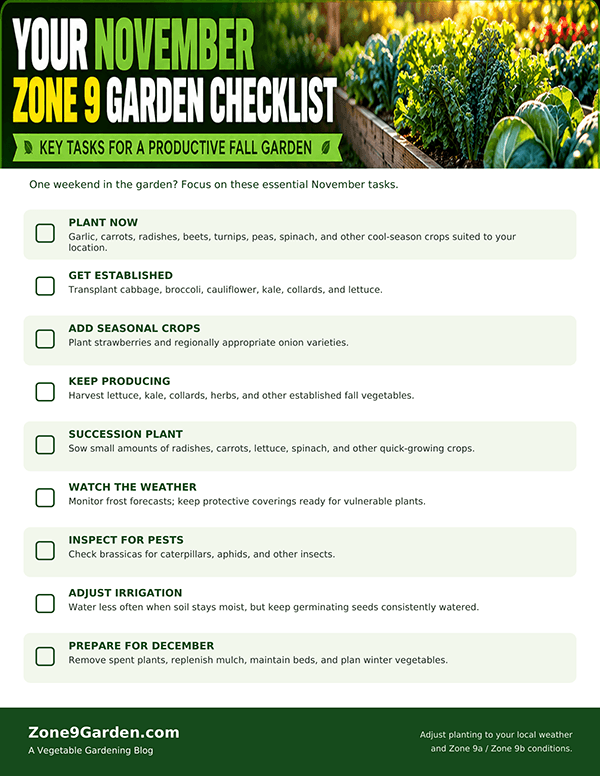
If you only have one weekend to work in the garden, concentrate on the most important November tasks.
Plant now: Garlic, carrots, radishes, beets, turnips, peas, spinach, and other cool-season crops suited to your local conditions.
Get established: Cabbage, broccoli, cauliflower, kale, collards, and lettuce transplants.
Add seasonal crops: Plant strawberries and regionally appropriate onion varieties.
Keep producing: Harvest lettuce, kale, collards, herbs, and other established fall vegetables.
Succession plant: Continue sowing small amounts of radishes, carrots, lettuce, spinach, and other quick-growing crops.
Watch the weather: Monitor frost forecasts and keep protective coverings available for vulnerable plants.
Inspect for pests: Check brassicas for caterpillars, aphids, and other insects.
Adjust irrigation: Reduce watering frequency when soil remains moist longer, but keep germinating seeds consistently watered.
Prepare for December: Remove exhausted plants, replenish mulch, maintain garden beds, and plan additional winter vegetables.
November is one of the months that makes gardening in Zone 9 so rewarding.
While much of the country is preparing for winter, Zone 9 gardeners are planting garlic, harvesting leafy greens, and filling their gardens with vegetables that thrive during cooler weather.
October established the cool-season garden.
November is when that garden begins to settle into its most productive period.
Whether you’re planting your first lettuce seeds or maintaining a garden full of broccoli, cabbage, carrots, and kale, November provides plenty of opportunities to keep growing.
For the bigger picture, visit our Zone 9 Fall Planting Guide to see what to plant throughout the season, or use our Zone 9 Planting Calendar to plan your garden throughout the entire year.
Related Zone 9 Garden Guides
Keep planning your fall and winter garden with these Zone9Garden.com guides:
- Zone 9 Planting Calendar: What to Plant Every Month — See what you can plant throughout the entire Zone 9 growing year.
- Zone 9 Fall Planting Guide — Plan your fall vegetable garden from late summer through the beginning of winter.
- Zone 9 Winter Planting Guide — Discover what to plant during December, January, and February.
- How to Grow Cabbage in Zone 9 — Learn how to plant, care for, and harvest cabbage during the cool season.
- How to Grow Cauliflower in Zone 9 — Learn the best planting times and techniques for producing healthy cauliflower heads.
- How to Grow Broccoli in Zone 9 — Learn how to grow broccoli successfully during fall and winter.
- What to Plant in October in Zone 9 — Review October planting recommendations and prepare for the transition into winter.