
Carrot
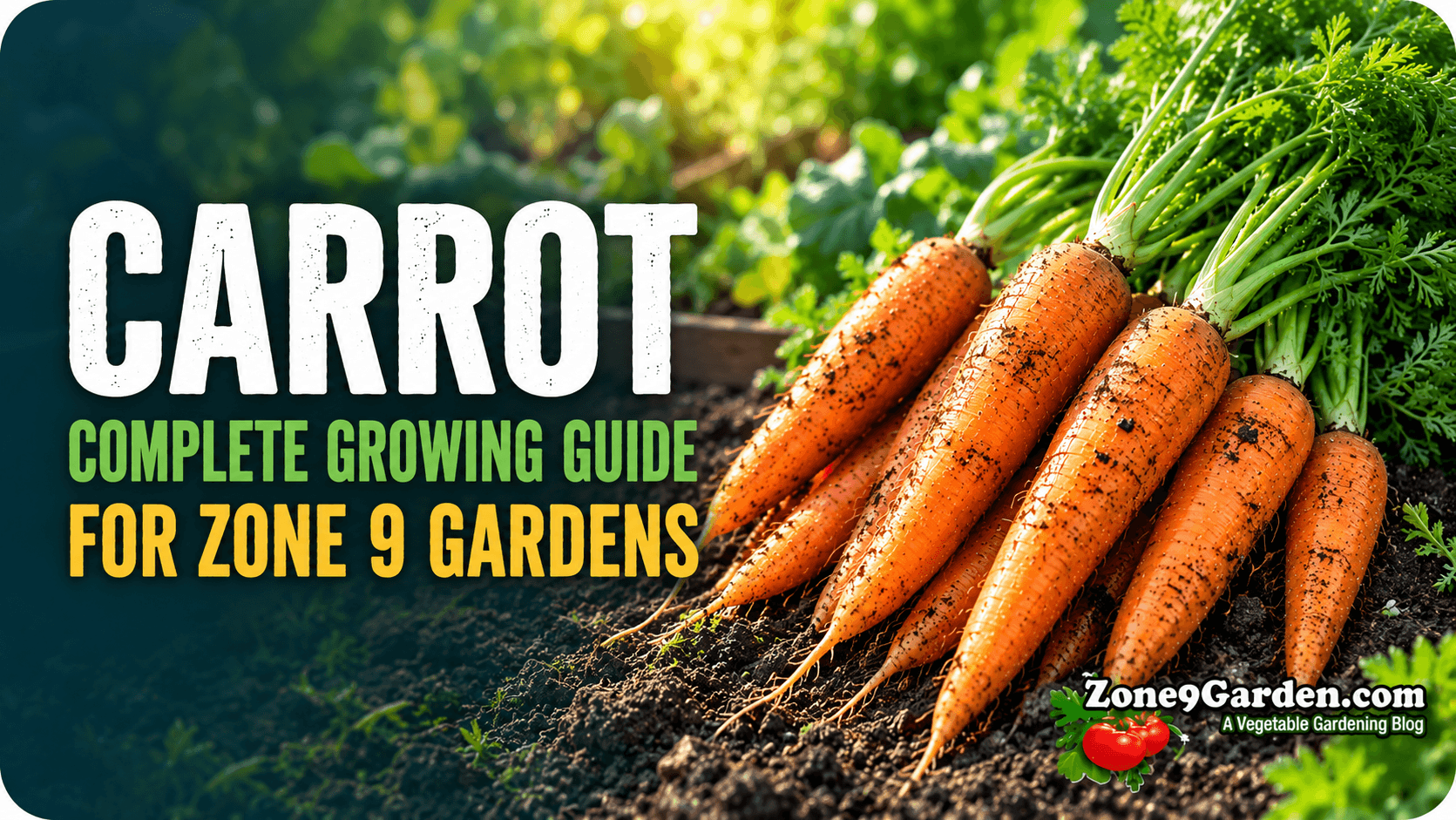
Carrot is a cool-season root vegetable in the Apiaceae, or carrot/parsley family. It is grown for its enlarged taproot, which may be orange, yellow, red, purple, or white depending on the cultivar.
Carrots perform best in loose, deep, stone-free soil that allows roots to develop straight and smoothly. Compacted, rocky, crusted, or waterlogged soil can produce forked, stubbed, cracked, or poorly shaped roots.
Zone 9 is well suited to carrots during the cooler months. Texas A&M reports ideal carrot temperatures of about 75°F during the day and 55°F at night, while Arizona recommends daytime temperatures around 65–70°F and nights around 40–60°F. High temperatures reduce root color and quality, so fall, winter, and early spring are the most reliable growing periods.
Full sun, 6+ hours daily; tolerates light partial shade
Vegetable / Cool-Season Root Crop
Planting Windows for Zone 9
| Stage | Spring | Fall |
|---|---|---|
| Start Indoors | Not Recommended | Not Recommended |
| Direct Sow | Jan 1 – Mar 15 | Aug 15 – Nov 15 |
| Transplant | Not Recommended | Not Recommended |
| Harvest | Mar 15 – Jun 15 | Oct 15 – Feb 28 |
Succession Planting: Direct sow additional carrots every 2–3 weeks through the appropriate planting window for a longer harvest.
Recommended Carrot Varieties
Danvers 126 — Classic tapered carrot recommended by Texas A&M; dependable in a range of garden soils and well suited to home gardens.
Danvers Half Long — Shorter Danvers-type carrot recommended by Texas A&M and UC ANR; a good choice where soil is not extremely deep.
Imperator 58 — Long, tapered carrot recommended by Texas A&M and UC ANR; best in deep, loose, stone-free soil.
Nantes — Cylindrical, blunt-ended carrot type recommended by Texas A&M and UC ANR; known for crisp texture and sweet flavor.
Scarlet Nantes — Nantes-type carrot recommended by Texas A&M and commonly used in home gardens for uniform, sweet roots.
Red Core Chantenay — Short, broad-shouldered carrot recommended by Texas A&M; useful in heavier or shallower soils.
Royal Chantenay — Chantenay-type carrot recommended by Texas A&M and UC ANR; shorter roots make it useful where deep loose soil is difficult to provide.
Sugar Snax — Sweet, slender carrot recommended by Texas A&M.
Little Finger — Short-rooted carrot recommended by Texas A&M and UC ANR; useful for containers, raised beds, and shallower soils.
Thumbelina — Small round carrot recommended by UC ANR; well suited to containers or heavy or shallow soils.
Fertilizer Schedule
Incorporate well-finished compost or organic matter and apply fertilizer according to a soil test. If no test is available, use only a modest amount of balanced fertilizer. Avoid fresh manure and excessive nitrogen because they can contribute to forked or overly hairy roots.
Keep fertilizer incorporated into the bed rather than concentrated directly against seed. Maintain even moisture during the long germination period.
Apply a light side-dressing if additional fertility is needed. Texas A&M recommends a small supplemental fertilizer application at this stage.
Apply a second light feeding only if tops are pale or growth indicates a nutrient need. Avoid heavy nitrogen, which can favor tops over root quality.
Routine additional feeding is usually unnecessary in adequately prepared soil. Maintain even moisture and avoid late heavy nitrogen applications.
Planting Details
0.25–0.5 inches
2–3 inches
12–18 inches
10–18 days under favorable conditions
60–75°F
40°F
65–75°F practical target
Growing Requirements
Full sun, 6+ hours daily; tolerates light partial shade
Consistent moisture; keep the root zone evenly moist without waterlogging.
Loose, deep, well-drained sandy loam or loam free of rocks, clods, and compaction.
6.0–6.5
Moderate feeder; avoid excessive nitrogen and fresh manure.
Preplant compost and soil-test fertilizer, modest balanced fertilizer before planting if needed, a light side-dressing when tops reach about 3–4 inches, and a second light feeding at 6–8 inches only if growth is pale or soil fertility is low.
Top 5 Common Carrot Pests
Aphids feed on carrot foliage and may cause curled or distorted leaves and plant stunting. Their greatest concern is virus transmission, including carrot motley dwarf and related virus diseases.
Larvae tunnel into carrot roots, leaving rusty brown feeding scars and winding tunnels. Damage may not become obvious until harvest and can make roots unmarketable or prone to decay.
Adults chew small pits or irregular holes in leaves. Young seedlings can be significantly weakened, and some flea beetle feeding may also scar carrot roots.
Larvae feed at night and may cut young carrot seedlings off at or near the soil line. Missing or severed seedlings often appear in patches.
Plants may become stunted or uneven, while edible roots can become forked, stubbed, swollen, or distorted. UF/IFAS specifically notes nematodes can cause forking in carrots.
Top 5 Common Carrot Diseases
Older leaves develop brown spots with yellow margins. Spots enlarge into dark brown or black irregular lesions on leaves and petioles; severe infection can give foliage a scorched appearance and weaken tops.
Small circular tan-to-brown lesions form on foliage, often with a yellow halo. Lesions enlarge, leaves yellow and curl at the margins, and severe infections can cause substantial foliage loss.
White powdery fungal growth develops on older leaves and petioles. Young leaves may develop circular white spots that enlarge, and infected foliage may show mild yellowing.
Roots develop soft, watery, slimy decay that may have a foul odor. The internal root can break down rapidly while outer skin remains partly intact; foliage may yellow, wilt, and collapse.
Small sunken elliptical to irregular lesions form on the carrot surface, often concentrated on the upper third of the taproot. Lesions darken and enlarge as roots mature.
Zone 9 Weather Patterns
Temperature, soil moisture, and drainage play major roles in carrot germination, root shape, flavor, and overall quality in Zone 9.
Significant freeze injury to exposed tops and roots becomes more likely.
Carrots tolerate light frost and often develop good flavor under cool conditions.
Biological minimum for carrot seed germination.
Suitable cool-season planting range.
Excellent practical germination and establishment range.
UC ANR broad optimum germination range.
Arizona favorable growing range.
Texas A&M ideal carrot temperatures.
Root color, sweetness, and overall quality decline; emergence may also suffer in hot crusted soil.
Greater risk of poor emergence, soil crusting, woody roots, and cracking from moisture swings.
Greater risk of cavity spot, soft rot, and other root diseases if drainage is poor.
Harvest
Harvest Window:
Spring: Mar 15 – Jun 15
Fall/Winter: Oct 15 – Feb 28
Harvest Indicators:
Roots have reached the expected diameter and length for the cultivar, shoulders are well colored, and roots are still tender. Many carrots are ready when shoulders are about 0.5–1 inch across, but final size varies by cultivar. Do not leave mature roots in warm soil too long because quality declines and roots may become tough or crack.
Harvest Instructions:
Loosen the soil beside mature roots with a garden fork or trowel and gently lift the carrot rather than pulling hard on the foliage. Harvest when roots are good-sized but still tender. During cool weather, mature carrots can often remain in the ground for a limited period and be harvested as needed, provided the soil does not freeze or become waterlogged.
Crop Relationships
Apiaceae — Carrot / Parsley Family
Apiaceae / Root Crops
Sweet Alyssum
Dill
Cilantro
Calendula
Marigolds
Celery
Parsley
Parsnips
Cilantro
Other Apiaceae crops
Helpful Links
- Zone 9 Planting Calendar — Use the year-round Zone 9 planting calendar to see when carrots and other cool-season vegetables fit into your garden schedule.
- Zone 9 Fall Planting Guide — Plan carrots alongside other fall and winter vegetables using the month-by-month Zone 9 fall planting guide.
- Zone 9 Spring Planting Guide — See how carrots fit into the transition from cool-season winter crops to the Zone 9 spring garden.
- Zone 9 January Planting Guide — January is an important carrot-growing month in Zone 9, with Danvers, Imperator, and Nantes among the recommended varieties.
| Data Sources & Methodology: The crop data presented in this guide represents standardized Zone 9 values derived from and averaged across guidance from UF/IFAS Extension, Texas A&M AgriLife Extension, University of Arizona Cooperative Extension, and UC Agriculture & Natural Resources. USDA establishes the Zone 9 plant-hardiness framework. Recommendations may vary by local climate, cultivar, soil conditions, microclimate, and individual growing conditions. |