

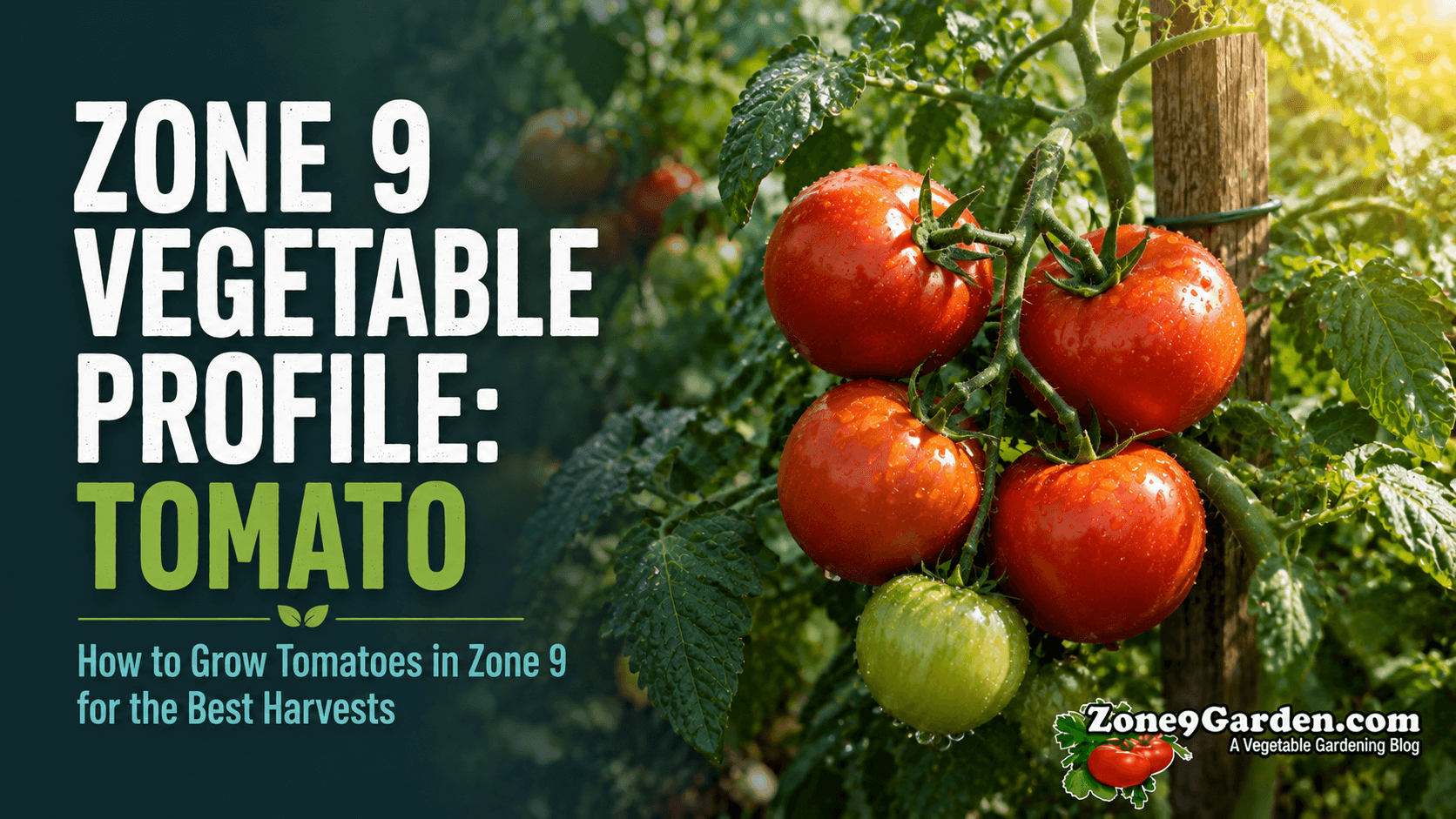
Tomato
Tomato is a frost-sensitive, warm-season member of the Solanaceae family grown primarily as an annual vegetable.
Determinate tomatoes grow to a relatively defined size and produce most of their fruit during a concentrated period.
Indeterminate tomatoes continue producing vines, flowers, and fruit throughout favorable growing conditions and generally require more substantial staking or caging.
Tomatoes are particularly valuable in Zone 9 because the long growing season can support both spring and fall production in many locations. However, Zone 9 heat can also become the crop’s biggest limitation. Arizona Extension reports that tomatoes thrive between approximately 50–90°F, while UC ANR identifies 80–90°F as optimum growth temperatures and notes that flowers may fail to set at approximately 100°F.
Full sun, 6–8+ hours daily
70–90 days from transplant
Vegetable / Warm-Season Annual
Planting Windows for Zone 9
| Stage | Spring | Fall |
|---|---|---|
| Start Indoors | Jan 15 – Feb 15 | Jun 15 – Jul 15 |
| Direct Sow | Mar 1 – Apr 15 | Jul 15 – Aug 15 |
| Transplant | Mar 1 – Apr 15 | Aug 1 – Sep 15 |
| Harvest | May 15 – Jul 15 | Oct 1 – Dec 15 |
Recommended Tomato Varieties
Celebrity — Medium-to-large slicer; widely adapted and disease resistant.
Bella Rosa — Determinate slicer with useful disease resistance and good warm-climate performance.
Early Girl — Early-producing indeterminate slicer; useful where extreme summer heat shortens the productive spring season.
Better Boy — Indeterminate slicer producing large fruit; Texas A&M lists it with resistance to Verticillium wilt, Fusarium wilt, and nematodes.
Big Beef — Large indeterminate slicer with good heat tolerance and resistance to Verticillium, Fusarium, and nematodes.
Heat Wave II — Heat-oriented slicer suited to warmer climates.
Juliet — Productive indeterminate grape tomato with relatively early maturity.
Sun Gold — Early, vigorous indeterminate cherry tomato.
Super Sweet 100 — Highly productive cherry tomato with useful disease resistance.
Cherokee Purple — Large-fruited heirloom valued for flavor, although generally less disease-resistant and less predictable under extreme heat.
Fertilizer Schedule
Incorporate compost or organic matter; apply fertilizer according to soil-test results.
Use a balanced starter fertilizer where needed; avoid excessive nitrogen.
Light side-dressing if plants require additional nutrients.
Light feeding; avoid pushing excessive leafy growth.
Maintain adequate nutrition, particularly nitrogen and potassium where soil testing indicates need.
Light supplemental feeding while plants remain productive.
Planting Details
0.5 inches
30 inches
42 inches
7–10 days
70–80°F
50°F
72–77°F
Growing Requirements
Full sun, 6–8+ hours daily
Consistent, deep watering; approximately 1–2 inches per week as a general garden target.
Fertile, medium-textured, well-drained soil rich in organic matter.
6.2–6.5 average
Moderate-to-heavy feeder; balanced preplant fertility followed by light side-dressing. Avoid excessive nitrogen.
Soil preparation 1–2 weeks before planting, starter fertilizer at planting when needed, light side-dressing after establishment, and supplemental feeding during flowering, fruit production, and continued harvest as needed.
Top 5 Common Tomato Pests
Leafhoppers
Sap feeding; particularly important because beet leafhoppers transmit curly top virus.
Tomato Fruitworm
Caterpillars feed directly on developing fruit.
Tomato Hornworms
Rapid defoliation; larvae consume leaves, stems, and sometimes fruit.
Whiteflies
Sap feeding, plant weakening, honeydew, and transmission of important tomato viruses.
Aphid
Sap feeding, distorted growth, honeydew, and transmission of viruses.
Top 5 Common Tomato Diseases
Powdery Mildew
Leaves first develop light-green or yellow blotches followed by brown areas. Powdery fungal growth may appear on leaf surfaces, and severely affected leaves turn brown, shrivel, and remain attached. UF/IFAS reports that tomato powdery mildew favors approximately 50–75°F and does not require free water on the foliage.
Tomato Spotted Wilt Virus
Leaves develop small brown flecks that enlarge and die; plants may become droopy and stunted. Fruit often develops distinctive yellow or brown concentric rings. The disease is transmitted by thrips. UF/IFAS identifies TSWV as an especially significant spring threat in parts of North Florida.
Tomato Yellow Leaf Curl Virus
New leaves become yellow around the margins and curl upward. Plants may develop small leaves, mottling, shortened internodes, severe stunting, flower drop, and greatly reduced fruit production. The virus is transmitted by silverleaf whiteflies.
Fusarium Wilt
Lower leaves yellow and wilt first, with symptoms progressing upward. Sometimes only one side of the plant is affected initially. Cutting into the stem may reveal yellow-to-brown vascular discoloration. Severely infected plants eventually wilt and die.
Early Blight
Brown to black lesions usually begin on older, lower leaves. Spots enlarge and develop distinctive concentric rings, often described as a target pattern. Stem lesions may become dark and sunken, while fruit can develop dark concentric lesions.
Zone 9 Weather Patterns
Weather is one of the most important factors determining tomato success in Zone 9.
Frost injury; plants may be killed.
Growth slows considerably.
Approximate minimum nighttime range for reliable fruit set.
Broad favorable growing range.
Optimum seed germination.
Optimum vegetative growth.
Pollination and fruit set begin declining.
Fruit set may become extremely poor or stop.
Greater water stress, blossom drop, sunscald, and cracking.
Greater fungal and bacterial disease pressure.
Increased blossom-end rot and fruit cracking.
Harvest
Days to Maturity: 70–90 days from transplant
Harvest Window:
Spring: May 15 – Jul 15
Fall: Oct 1 – Dec 15
Harvest Indicators:
Fruit has reached its expected mature size and characteristic cultivar color; ripe fruit should be firm but yield slightly to gentle pressure. Fruit beginning to color can also be harvested and allowed to finish ripening indoors.
Harvest Instructions:
Gently twist or clip fruit from the vine without damaging the stem or nearby fruit. Harvest ripe tomatoes promptly rather than leaving them on the plant unnecessarily. If rain is expected, harvest mature fruit beforehand to reduce cracking and fruit molds. Late-season full-sized green tomatoes can be harvested and ripened indoors at approximately 70°F.
Crop Relationships
Solanaceae — Nightshade Family
Solanaceae / Fruiting Vegetable
Basil
Marigolds
Sweet Alyssum
Borage
Chives
Garlic
Parsley
Cilantro
Thyme
Nasturtiums
Potatoes
Bell Peppers
Hot Peppers
Eggplant
Fennel
Corn
Cabbage
Broccoli
Black Walnut
Helpful Links
-
- Tomatoes stop producing during Zone 9 summer heat -Learn why Zone 9 tomatoes stop flowering and producing fruit during extreme summer heat and what you can do to keep plants healthy.
- Prevent blossom end rot in tomatoes – Learn what causes blossom end rot in tomatoes and how proper watering, nutrition, and soil management can help prevent it.
- Grow Roma tomatoes for a fall harvest – Discover how to plant and grow Roma tomatoes for a productive fall harvest in Zone 9.
- Zone 9 Fall Planting Guide – Use this month-by-month Zone 9 fall planting guide to plan tomatoes and other vegetables for the cooler growing season.
- Why prune lower leaves of tomato plants? –
| Data Sources & Methodology: The crop data presented in this guide represents standardized Zone 9 values derived from and averaged across guidance from UF/IFAS Extension, Texas A&M AgriLife Extension, University of Arizona Cooperative Extension, and UC Agriculture & Natural Resources. USDA establishes the Zone 9 plant-hardiness framework. Recommendations may vary by local climate, cultivar, soil conditions, microclimate, and individual growing conditions. |