
Bell Pepper
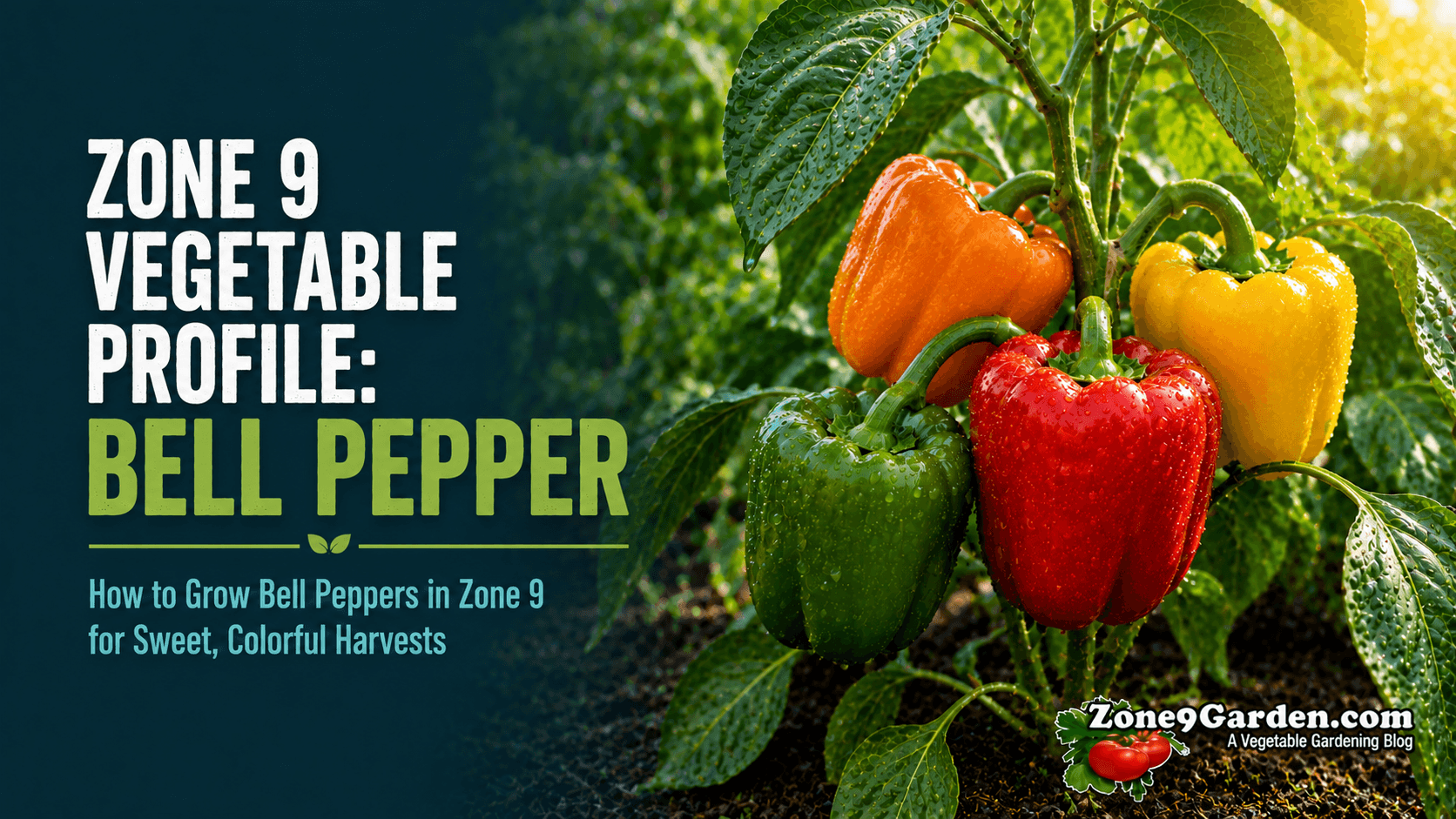
Bell pepper is a warm-season, frost-sensitive vegetable in the Solanaceae (nightshade) family. Bell peppers are sweet peppers with essentially no capsaicin heat and generally produce thick-walled, blocky fruits that may be harvested green or allowed to mature to red, yellow, orange, or other colors depending on the cultivar. UF/IFAS identifies bell pepper specifically as Capsicum annuum and notes that mature fruit color varies by cultivar.
Bell peppers require a relatively long period of warm weather and are generally more sensitive to temperature extremes than many hot peppers. UC ANR reports best growth with approximately 75–85°F daytime temperatures and 55–65°F nighttime temperatures. Frost damages or kills plants, while temperatures around or above 100°F reduce pollination, fruit set, and yield.
Zone 9 often provides two useful production periods: a spring crop before extreme summer heat and a fall crop after peak heat moderates.
6–8+ hours daily
65–80 days from transplant
Vegetable / Warm-Season Annual
Planting Windows for Zone 9
| Stage | Spring | Fall |
|---|---|---|
| Start Indoors | Jan 15 – Feb 15 | Jun 15 – Jul 15 |
| Direct Sow | Mar 15 – Apr 15 | Jul 15 – Aug 15 |
| Transplant | Mar 15 – Apr 30 | Aug 1 – Sep 15 |
| Harvest | Jun 1 – Aug 15 | Oct 1 – Dec 15 |
Recommended Bell Pepper Varieties
California Wonder — Classic open-pollinated bell pepper producing thick-walled green fruit that matures red; widely used as a home-garden standard.
Ace — Early sweet bell pepper especially useful where the productive warm-season window is limited. University of Arizona Extension specifically lists Ace as a popular sweet pepper variety.
Antebellum — Sweet green bell pepper with concentrated fruit set and resistance to several bacterial spot races, tobacco mosaic virus, and intermediate resistance to tomato spotted wilt virus. UF/IFAS lists it for Florida production.
Aristotle — Blocky commercial bell pepper used successfully in warm Florida production systems and included in UF/IFAS bell pepper variety recommendations.
Boca — Dark-green, thick-walled bell pepper with resistance to bacterial spot and tomato spotted wilt virus.
Green Machine — Main-season bell pepper suited to both spring and fall production, producing dark-green blocky fruit that matures red; UF/IFAS lists resistance to tobacco mosaic virus and bacterial spot races.
Blitz — Early-maturing, large blocky bell with strong early yield potential and disease resistance.
Gypsy — Sweet pepper repeatedly grown in UC ANR demonstration gardens and useful where a somewhat earlier sweet pepper is desired.
Fertilizer Schedule
Incorporate compost or organic matter and apply fertilizer according to soil-test recommendations.
Apply a balanced starter fertilizer if needed. Texas A&M recommends incorporating approximately 2–3 pounds of a fertilizer such as 10-10-10 per 100 square feet where soil testing does not indicate a different program.
Light nitrogen side-dressing if plant growth indicates a need.
Apply another light side-dressing.
Continue light supplemental feeding as required by plant performance and soil fertility; avoid excessive nitrogen.
Planting Details
0.5 inches
18 inches
36 inches
10–14 days
75–85°F
60°F
80°F average
Growing Requirements
6–8+ hours daily
Approximately 1–1½ inches per week, adjusted for heat and soil.
Fertile, well-drained loam or sandy loam rich in organic matter.
6.0–6.8
Moderate-to-heavy feeder; balanced fertilizer with controlled nitrogen.
Preplant compost + balanced fertilizer according to soil test → starter fertilizer at transplanting if needed → light nitrogen side-dressing at approximately 4 weeks → second light side-dressing at approximately 8 weeks / early fruit development → supplemental feeding during extended harvest only if plant vigor or soil fertility indicates a need.
Top 5 Common Bell Pepper Pests
Aphids
Clusters of soft-bodied insects occur on young leaves and shoots. Leaves may curl, yellow, or become distorted. Sticky honeydew may cover foliage and encourage sooty mold. Aphids can also transmit pepper viruses.
Thrips
Feeding produces distorted, curled, puckered, or scarred leaves. Flowers and young fruit can also be damaged. Thrips are particularly important because some species transmit Tomato Spotted Wilt Virus.
Pepper Weevil
Adults feed on buds and fruit. Larvae develop inside peppers, feeding around the seed core. Infested fruit may become misshapen, turn yellow prematurely, drop from the plant, or contain internal feeding damage and frass.
Beet Armyworm
Young larvae skeletonize or chew foliage, while older caterpillars make irregular holes and may feed on developing fruit. Heavy infestations can cause substantial defoliation. Feeding is often accompanied by webbing and frass.
Whiteflies
Adults and immature stages feed on leaf undersides, resulting in yellowing, reduced vigor, and sticky honeydew. Large populations may contribute to sooty mold and can transmit viral diseases.
Top 5 Common Bell Pepper Diseases
Bacterial Spot
Small water-soaked angular spots develop on leaves and later turn brown. Severe infections cause leaf drop. Fruit develops raised, rough, cracked, scab-like lesions.
Phytophthora Blight / Root and Crown Rot
Plants may wilt suddenly despite apparently adequate moisture. Roots and crowns develop dark, water-soaked brown lesions, and severely infected plants collapse and die. Fruit may also rot.
Anthracnose
Small water-soaked fruit lesions enlarge into sunken tan, dark-red, or black spots. Salmon-colored fungal structures may develop in concentric rings. Infection may occur while fruit is immature but remain invisible until peppers ripen.
Mosaic Viruses
Leaves may become mottled light and dark green, narrowed, distorted, or curled. Plants can become stunted and produce small, malformed, or poorly colored fruit. Aphid-transmitted cucumber mosaic virus is one important example.
Tomato Spotted Wilt Virus
Young foliage may bronze, develop rings or necrotic spots, and become distorted. Plants may become severely stunted. Fruit can develop irregular rings, blotches, or discoloration. The virus is transmitted by thrips.
Zone 9 Weather Patterns
Bell peppers are highly temperature-sensitive.
Frost can severely damage or kill plants.
Growth and fruit development slow substantially.
Favorable nighttime range.
Optimum daytime growing range.
Flower and young-fruit drop becomes more likely, particularly when combined with hot nights.
Pollination, fruit set, and yield decline substantially.
Increased wilting, blossom drop, blossom-end rot, and sunscald.
Greater bacterial spot, Phytophthora, anthracnose, and fruit-rot pressure.
Can reduce fruit set and contribute to blossom-end rot.
Harvest
Days to Maturity: 65–80 days from transplant
Harvest Window:
Spring: June 1 – August 15
Fall: October 1 – December 15
Harvest Indicators:
Bell peppers may be harvested when fruits have reached full size, become firm, glossy, and thick-walled. Green bells are simply mature peppers harvested before full color development. Leaving fruit on the plant allows it to mature to its cultivar’s final red, yellow, orange, or other color and usually develops a sweeter flavor.
Harvest Instructions:
Cut peppers from the plant with pruners or scissors, leaving a short portion of stem attached. Do not pull or twist aggressively because pepper branches are brittle and can break. UC ANR specifically recommends cutting rather than pulling fruit.
Crop Relationships
Solanaceae — Nightshade Family
Solanaceae / Fruiting Vegetable
Companion Plants
Onions
Garlic
Chives
Sweet Alyssum
Marigolds
Basil
Calendula
The strongest Extension support is for onions near peppers, which UC Master Gardeners note may help discourage aphids, and for flowering/insectary plants such as sweet alyssum, marigolds, and calendula that attract beneficial insects. UF/IFAS also documents sweet alyssum and marigolds as useful resources for beneficial arthropods.
Plants to Avoid
Tomatoes
Potatoes
Eggplant
Hot Peppers when seed purity matters
The first three are primarily rotation avoids, not necessarily plants that physically harm bell peppers when grown nearby. They belong to the same Solanaceae family and share diseases and pests, so peppers should not repeatedly follow them in the same soil. UC ANR specifically recommends that peppers not be planted where tomatoes, potatoes, eggplants, or other nightshades were recently grown.
Helpful Links
Sowing Pepper Seeds
— Zone9Garden guide to starting pepper seeds and improving germination.
Zone 9 Spring Planting Guide
— Spring planting guidance for peppers and other Zone 9 vegetables.
Zone 9 Fall Planting Guide
— Timing and crop guidance for the productive Zone 9 fall gardening season.
15 Heat-Tolerant Vegetables That Thrive in Zone 9 Summers
— A guide to vegetables, including peppers, that handle Zone 9 summer heat.
| Data Sources & Methodology: The crop data presented in this guide represents standardized Zone 9 values derived from and averaged across guidance from UF/IFAS Extension, Texas A&M AgriLife Extension, University of Arizona Cooperative Extension, and UC Agriculture & Natural Resources. USDA establishes the Zone 9 plant-hardiness framework. Recommendations may vary by local climate, cultivar, soil conditions, microclimate, and individual growing conditions. |
| UF/IFAS Extension • Texas A&M AgriLife Extension • University of Arizona Cooperative Extension • UC Agriculture & Natural Resources • USDA Plant Hardiness Zone Map |