
September is one of the most important months in the Zone 9 vegetable garden. Summer isn’t quite finished, but the fall growing season is beginning.
That creates an unusual overlap: heat-loving vegetables may still be producing while beans, leafy greens, root vegetables, and cool-season crops begin moving into the garden.
For many Zone 9 gardeners, September is less about ending the summer garden and more about starting the second major growing season of the year.
The exact crops you should plant depend on where you live. Zone 9 stretches across several very different climates, including parts of Florida, Texas, Louisiana, Arizona, and California. USDA hardiness zones describe winter minimum temperatures, not identical growing conditions, so local weather should always take priority over a national planting calendar.
Still, September offers plenty of opportunities across Zone 9. Here’s a quick guide to getting your fall garden started.
What Can You Plant in September in Zone 9?
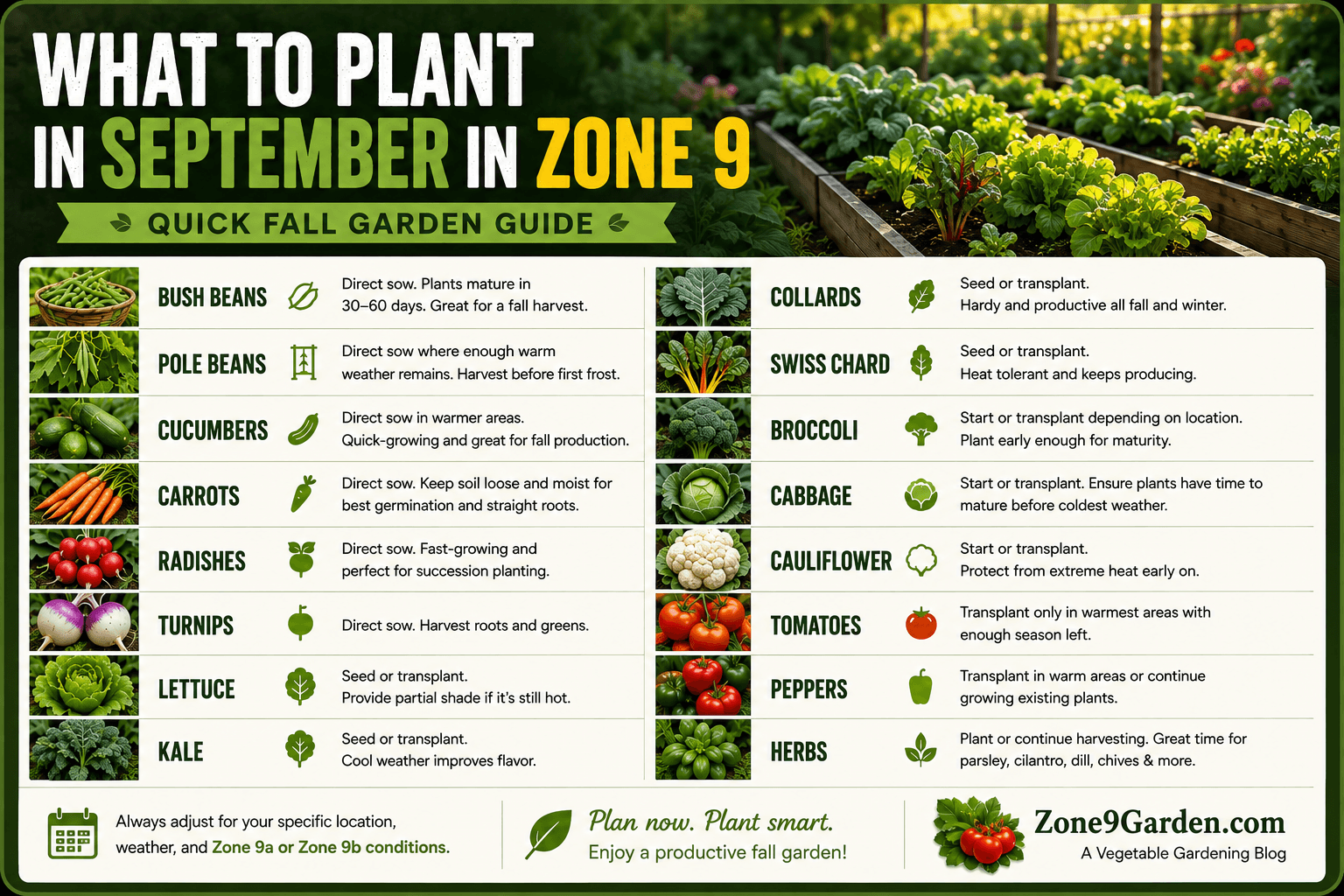
For a quick starting point, these are some of the vegetables worth considering this month:
| Crop | September Strategy |
|---|---|
| Bush beans | Direct sow |
| Pole beans | Direct sow where enough warm weather remains |
| Cucumbers | Direct sow in warmer areas |
| Carrots | Direct sow where local temperatures are suitable |
| Radishes | Direct sow |
| Turnips | Direct sow |
| Lettuce | Seed or transplant as temperatures moderate |
| Kale | Seed or transplant |
| Collards | Seed or transplant |
| Swiss chard | Seed or transplant |
| Broccoli | Start or transplant depending on location |
| Cabbage | Start or transplant depending on location |
| Cauliflower | Start or transplant depending on location |
| Beets | Direct sow where conditions are suitable |
| Tomatoes | Transplant only in warmer Zone 9 climates with enough season remaining |
| Peppers | Continue growing or transplant in the warmest areas |
These aren’t universal planting dates. For example, UF/IFAS lists September planting options that differ between North, Central, and South Florida, while Texas A&M’s fall calendar shifts planting dates substantially between its Zone 9A and Zone 9B regions.
Think of this list as your September starting point, then adjust it for your local climate.
Beans
September can still offer a useful planting window for bush and pole beans, particularly where warm weather will continue well into fall.
Beans are especially useful during this transitional period because they grow relatively quickly. Texas A&M lists bush beans among vegetables that can mature in roughly 30–60 days and recommends planting snap bush beans about 8–10 weeks before the first freeze.
Direct sow beans into warm soil and keep the seedbed consistently moist while they germinate.
The big question is how much warm weather you have left.
Gardeners in frost-prone parts of Zone 9 need to plant early enough for beans to produce before cold weather arrives. Gardeners in warmer locations may have considerably more flexibility.
Lettuce and Leafy Greens
September begins the return of lettuce, kale, collards, mustard greens, and other leafy vegetables.
But don’t let the calendar fool you.
Early September can still be extremely hot in Zone 9.
Lettuce in particular may struggle with germination and heat stress when temperatures remain high. If you’re still experiencing midsummer conditions, wait for temperatures to moderate or give young plants some afternoon protection.
Kale and collards can be easier crops for beginning the transition.
UF/IFAS includes kale and lettuce among September transplanting options throughout Florida, although recommendations vary by region.
Instead of planting an entire bed of lettuce at once, consider succession planting.
Plant a small amount, wait a week or two, and plant another round. As temperatures improve, later plantings may perform better while also spreading out your harvest.
Radishes and Turnips
If you want something fast for the fall garden, radishes are hard to beat.
They take relatively little garden space, and Texas A&M categorizes radishes and turnips among quick-maturing fall vegetables.
Direct sow them where they’ll grow rather than transplanting them.
They also work well for succession planting. A small planting every couple of weeks can provide a much longer harvest than sowing an entire packet at once.
Turnips offer another benefit: depending on the variety, you can harvest both the roots and the greens.
Carrots and Beets
September may also open planting opportunities for root vegetables, but this is an area where location within Zone 9 matters considerably.
UF/IFAS includes carrots among September-seeded crops in North and Central Florida. Texas A&M’s regional fall calendar, however, demonstrates how dramatically the ideal carrot planting date can shift as you move between climates.
Carrots should be direct sown.
Prepare the bed before planting by removing rocks, clods, roots, and other obstructions. Loose soil makes it easier for the roots to develop normally.
The biggest challenge is often keeping the shallowly planted seeds moist during warm September weather.
Check the seedbed frequently during germination rather than allowing the soil surface to repeatedly dry out.
Broccoli, Cabbage, and Cauliflower
September is also when broccoli, cabbage, cauliflower, and other cole crops start becoming much more important.
In some Zone 9 locations, September is transplanting time. In hotter locations, it may still be better to start seedlings and wait for more favorable weather.
Texas A&M’s fall recommendations illustrate this perfectly: average planting dates for broccoli, cabbage, and cauliflower range from September 1 in one Texas region to October or November farther south.
That’s why I’d avoid treating September 1 as a universal deadline.
If afternoon temperatures are still punishing, start seedlings where you can protect them and transplant once conditions improve.
If you’re buying transplants, look for compact, healthy plants rather than oversized plants that have been sitting in containers too long.
Cucumbers and Squash
Don’t assume September means warm-season vegetables are finished.
In warmer parts of Zone 9, there may still be time for another crop of cucumbers or summer squash.
UF/IFAS includes cucumbers and squash among September seed options in Central Florida, while Texas A&M recommends September cucumber planting in some of its warmer gardening regions.
These crops grow quickly in warm soil.
The limitation is what’s coming rather than what’s happening today.
Before planting, consider your expected first frost and the variety’s days to maturity. You need enough warm weather remaining for the plants to mature and produce.
What About Tomatoes and Peppers?
September tomatoes are highly location-dependent.
In some of the warmest Zone 9 climates, this can still be an important tomato-growing period. UF/IFAS lists tomatoes and peppers among September transplant options in Central and South Florida.
In locations with an earlier frost, however, starting a new tomato plant in September may simply be too late.
If you already have healthy tomatoes and peppers growing, don’t automatically pull them because September arrived.
Plants that survived summer may become more productive as temperatures moderate.
Clean them up, remove obviously diseased growth, keep them watered, and see what the fall weather brings.
September Herbs
Don’t forget the herb garden.
September can be a good time to begin transitioning from heat-loving summer herbs toward herbs that appreciate milder fall weather.
Depending on your location, consider:
- Parsley
- Cilantro
- Dill
- Rosemary
- Chives
- Mint
- Mexican tarragon
UF/IFAS specifically recommends several of these for fall and winter gardening in Florida.
Basil may also continue producing while temperatures remain warm.
Don’t Plant the Whole Fall Garden Yet
This may be the most important September gardening tip.
You don’t have to plant everything now.
October will bring additional opportunities.
The Zone 9 fall garden works better as a transition than as a single planting weekend.
In September, concentrate on crops suited to your current temperatures. Start seedlings for crops that need cooler conditions. As temperatures fall, gradually add more lettuce, carrots, spinach, broccoli, cabbage, cauliflower, onions, and other cool-season vegetables.
This staggered approach also prevents your entire garden from becoming ready to harvest at once.
Prepare Your Garden for Fall
September is also an excellent time to reset garden beds that struggled through summer.
Remove exhausted plants and weeds. If plants were heavily affected by disease, don’t simply work the infected material back into the bed.
Texas A&M recommends clearing old plant material before establishing the fall garden and stresses good drainage and adequate sunlight when selecting a vegetable-growing area.
Then:
- Add finished compost if the soil needs organic matter.
- Check irrigation before planting.
- Replace or replenish mulch.
- Remove weeds before they set more seed.
- Plan where taller fall crops will go.
- Make room for succession plantings.
Don’t over-fertilize simply because you’re starting a new season. Base fertilizer decisions on the crop, your soil, and ideally a soil test.
September Watering in Zone 9
September may say “fall” on the calendar, but your garden may still feel like summer.
New seeds and transplants need particular attention.
Keep newly seeded beds consistently moist during germination. Once plants establish larger root systems, transition toward deeper watering rather than frequent shallow watering.
Mulch can help reduce evaporation and moderate soil temperatures, but don’t bury newly germinating seedlings beneath a thick layer.
Also remember that September rainfall varies enormously across Zone 9.
Water according to the soil—not the calendar.
Zone 9a vs. Zone 9b in September
Your hardiness zone is useful, but it doesn’t tell the entire story.
Two Zone 9 gardens can have very different September conditions.
A Zone 9 gardener in a humid southeastern climate may be dealing with heavy rainfall and disease pressure while another Zone 9 gardener in the Southwest is dealing with dry heat.
Even within one state, recommended planting dates can shift considerably. Texas A&M’s regional fall calendar, for example, shows different planting dates between areas classified as USDA Zone 9A and 9B.
Use this guide to identify what crops you should be thinking about, then check your local Extension planting calendar and current weather before planting.
Your September Zone 9 Garden Checklist
If you only have a weekend to work on the garden, keep it simple.
Plant now: beans, radishes, turnips, appropriate root crops, and other vegetables suited to your local September conditions.
Begin transitioning: lettuce, kale, collards, broccoli, cabbage, cauliflower, and other cool-season vegetables.
Keep producing: healthy tomatoes, peppers, eggplant, and other warm-season plants that still have productive life left.
Prepare for October: clean beds, add compost where needed, check irrigation, and leave room for the next round of cool-season vegetables.
September doesn’t have to mean the end of your summer garden.
In Zone 9, it means the fall garden is just getting started.
For the bigger picture, use our Zone 9 Fall Planting Guide to see what to plant throughout fall.