
Cabbage
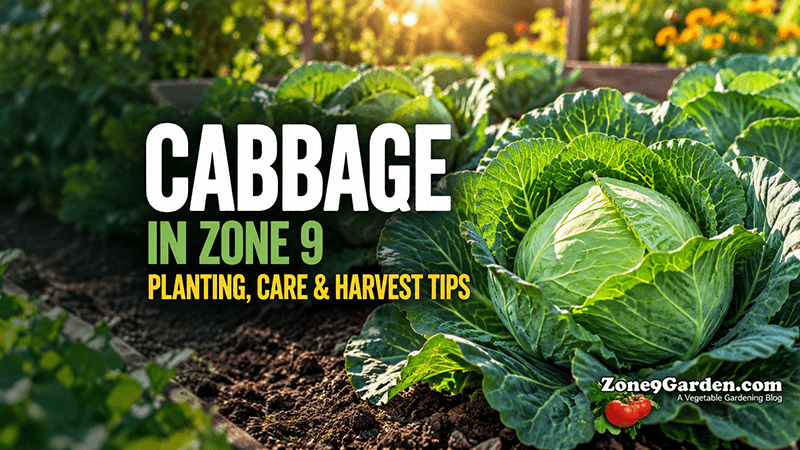
Cabbage is a hardy, cool-season vegetable in the Brassicaceae, or mustard/cabbage family. It forms a dense head of overlapping leaves and is commonly grown as green, red, or savoy cabbage. Cabbage performs best in fertile, well-drained soil with consistent moisture and cool temperatures during head development.
Zone 9 is especially well suited to fall, winter, and early-spring cabbage production. UF/IFAS lists cabbage planting from September through February in North and Central Florida and September through January in South Florida. UC ANR identifies average air temperatures around 60–65°F as ideal for cole crops, while Arizona Extension recommends cool daytime and nighttime temperatures for successful transplant establishment and head development.
Full sun to light partial shade; 6–8+ hours daily preferred
70 days
Vegetable / Cool-Season Cole Crop
Planting Windows for Zone 9
| Stage | Spring | Fall |
|---|---|---|
| Start Indoors | Dec 15 – Jan 31 | Jul 15 – Aug 31 |
| Direct Sow | Jan 1 – Feb 15 | Aug 15 – Oct 15 |
| Transplant | Jan 15 – Mar 1 | Sep 1 – Nov 15 |
| Harvest | Mar 15 – May 31 | Nov 1 – Feb 28 |
Recommended Cabbage Varieties
Bravo — Green hybrid cabbage recommended by UF/IFAS for Florida production.
Bronco — Green hybrid cabbage recommended by UF/IFAS; produces uniform heads and is widely used in warm-region production.
Cheers — Green hybrid cabbage recommended by UF/IFAS.
Grand Vantage — Green hybrid cabbage recommended by UF/IFAS.
Early Jersey Wakefield — Early green heading cabbage recommended by Texas A&M; useful where a shorter cool-season window is available.
Blue Dynasty — Green heading cabbage recommended by Texas A&M.
Red Dynasty — Red cabbage recommended by UF/IFAS and Texas A&M.
Red Jewel — Red hybrid cabbage recommended by UF/IFAS.
Savoy King — Savoy cabbage recommended by UF/IFAS and Texas A&M.
Savoy Ace — Savoy cabbage included in Texas A&M regional recommendations.
Fertilizer Schedule
Incorporate finished compost or organic matter and apply fertilizer according to a soil test. If organic matter has not been incorporated, use a balanced fertilizer containing nitrogen and phosphorus at a moderate rate.
Use starter fertilizer if needed and water transplants thoroughly. Keep concentrated fertilizer away from roots and stems.
Apply a light nitrogen side-dressing. UC ANR recommends side-dressing at about 3–4 inches tall, and Texas A&M recommends side-dressing leafy crops such as cabbage after several sets of true leaves develop.
Use light supplemental nitrogen only where plant color, vigor, sandy soil, or nutrient-leaching rainfall indicates a need. Maintain balanced fertility as heads enlarge.
Avoid heavy late nitrogen applications. Maintain even moisture while heads mature and harvest promptly when heads are firm.
Planting Details
0.25–0.5 inches
12–18 inches
24–36 inches
4–10 days under favorable conditions
60–85°F optimum range; about 70–77°F is an excellent target
40°F biological germination minimum
60–70°F practical planting and establishment range; about 70°F is ideal for rapid germination
Growing Requirements
Full sun to light partial shade; 6–8+ hours daily preferred
Consistent, deep watering; keep soil evenly moist without waterlogging, especially during head formation
Fertile, well-drained loam or sandy loam rich in organic matter; avoid compacted soil and poor drainage
6.0–6.5
Moderate-to-heavy feeder; requires adequate nitrogen for leaf and head development while avoiding excessive late nitrogen
Preplant compost and soil-test fertilizer, starter fertilizer at transplanting if needed, light nitrogen side-dressing during early growth, supplemental feeding every 3–4 weeks only if needed through head development, and no heavy late nitrogen as heads mature.
Top 5 Common Cabbage Pests
Velvety green caterpillars chew irregular holes in leaves and may feed into developing heads. Heavy feeding can skeletonize foliage and contaminate heads with frass.
Green looping caterpillars chew irregular holes in leaves and heads. Heavy populations reduce leaf area and can contaminate harvested heads.
Small green larvae feed mainly on leaf undersides, first creating translucent window-like patches and later small holes. Larvae may also feed on developing heads.
Dense gray-green aphid colonies feed on leaves and inside developing heads. Leaves may curl, yellow, or become distorted, and heavy infestations can stunt plants and contaminate heads.
Adults chew numerous small round shot holes in leaves. Heavy feeding can stunt or severely weaken young plants before they become established.
Top 5 Common Cabbage Diseases
Yellow V-shaped lesions develop from leaf margins toward the midrib, and veins may turn dark or black. Severe infection causes leaf death, stunting, poor head formation, and systemic vascular discoloration.
Roots become enlarged, swollen, and club-shaped. Aboveground plants are stunted, yellow, and may wilt during warm parts of the day even when soil moisture is adequate.
Pale yellow or irregular spots develop on upper leaf surfaces while gray-white fungal growth may appear underneath. Severe infection causes leaf yellowing, browning, and premature death.
Lower leaves yellow, wilt, and may curve to one side. Vascular tissue can become brown or dark, and severe infection causes stunting, one-sided growth, or plant death.
Small dark circular leaf spots enlarge and often develop concentric rings or target-like patterns. Severe infection causes leaf blighting and reduces healthy leaf area around developing heads.
Zone 9 Weather Patterns
Temperature and moisture have a major influence on cabbage establishment, head development, maturity, and disease pressure in Zone 9.
Freeze injury becomes increasingly likely, especially to young plants and developing heads; established cabbage is frost tolerant and can withstand temperatures below 32°F.
Established cabbage tolerates light frost and cool weather well.
Biological minimum for seed germination.
UC ANR optimum seed-germination range; about 70°F is an excellent target.
Ideal general growing range for cabbage and other cole crops.
Young plants may be stimulated toward premature seed-stem elongation or bolting.
Heat stress increases and head formation or quality can decline, with greater risk as temperatures rise into the mid-80s.
Greater risk of wilting, poor head development, tipburn, and increased insect pressure.
Greater risk of downy mildew, black rot, clubroot, damping-off, and other diseases.
Can contribute to head splitting, especially after dry soil is followed by heavy rain or irrigation.
Harvest
Days to Maturity:
70 days
Harvest Window:
Spring: March 15 – May 31
Fall/Winter: November 1 – February 28
Harvest Indicators:
Heads are full-sized for the cultivar, firm, dense, and well filled when squeezed gently. Harvest promptly once mature because overmature heads can split, bolt, or decline in quality.
Harvest Instructions:
Cut mature heads at the base with a clean sharp knife, leaving several wrapper leaves to protect the head. Harvest as soon as heads are firm and mature. Do not leave mature heads in the garden too long because warm weather, rapid growth, or moisture fluctuations can contribute to splitting or bolting.
Crop Relationships
Brassicaceae — Mustard / Cabbage Family
Brassicaceae / Cole Crops
Helpful Links
- Zone 9 Planting Calendar — Use the year-round planting calendar to see when cabbage and other cool-season vegetables fit into your Zone 9 garden.
- Zone 9 Fall Planting Guide — Plan cabbage alongside broccoli, cauliflower, lettuce, kale, and other vegetables suited to the Zone 9 fall and winter growing season.
- What to Plant in September in Zone 9 — Learn how to prepare the fall garden and begin transitioning into cool-season crops such as cabbage.
- NPK Fertilizer Explained — Learn how nitrogen, phosphorus, and potassium affect vegetable growth and how to understand fertilizer labels.
|
Data Sources & Methodology: The crop data presented in this guide represents standardized Zone 9 values derived from and averaged across guidance from UF/IFAS Extension, Texas A&M AgriLife Extension, University of Arizona Cooperative Extension, and UC Agriculture & Natural Resources. USDA establishes the Zone 9 plant-hardiness framework. Recommendations may vary by local climate, cultivar, soil conditions, microclimate, and individual growing conditions. |