
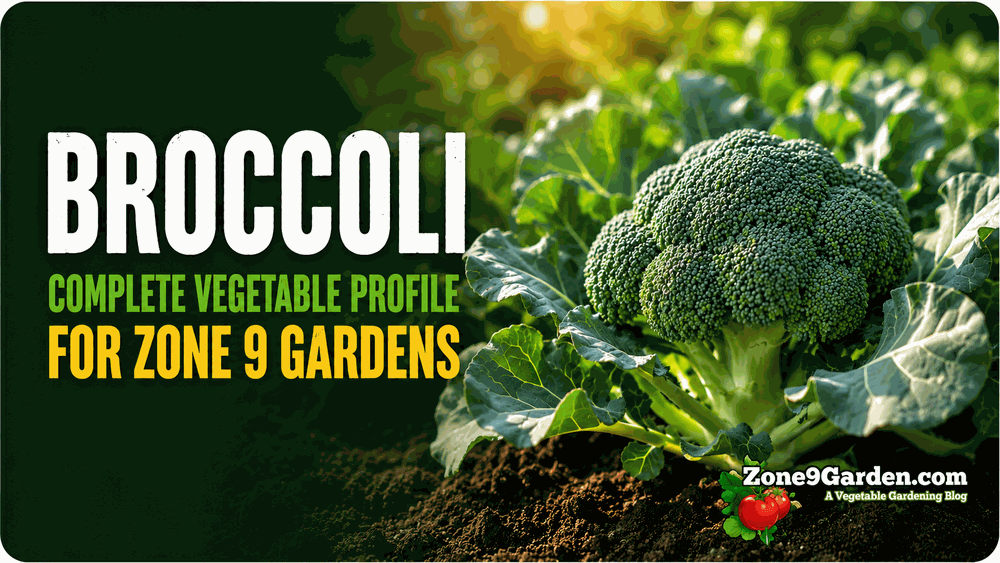
Broccoli
Broccoli is a hardy, cool-season vegetable in the Brassicaceae, or cabbage/mustard family. The primary edible portion is the immature flower head, although the tender stem, leaves, and smaller side shoots are also edible.
Broccoli performs best when it matures during cool weather. UC ANR identifies average air temperatures around 60–65°F as ideal for cole crops. High temperatures can cause loose heads, premature flowering, reduced head size, and bolting, while very cold conditions during early plant development can cause stunting or small “button” heads.
Broccoli works especially well as a fall and winter crop in Zone 9, although an early spring crop is also possible. UF/IFAS lists outdoor broccoli planting from roughly September through February in North and Central Florida and October through January in South Florida.
Full sun, 6–8+ hours daily
60–90 days from transplant
Vegetable / Cool-Season Annual
Planting Windows for Zone 9
| Stage | Spring | Fall |
|---|---|---|
| Start Indoors | Dec 15 – Jan 31 | Jul 15 – Aug 31 |
| Direct Sow | Jan 15 – Feb 28 | Aug 15 – Oct 1 |
| Transplant | Jan 15 – Mar 1 | Sep 1 – Nov 1 |
| Harvest | Mar 15 – May 15 | Nov 1 – Feb 28 |
Recommended Broccoli Varieties
Green Magic — Compact, productive hybrid specifically recommended by Texas A&M; also recognized by UC ANR for producing large heads.
Packman — Early-maturing broccoli recommended by Texas A&M and UC ANR. Particularly useful where the cool growing window is limited.
Premium Crop — Large-headed broccoli recommended by Texas A&M.
Belstar — Large-headed hybrid that produces additional side shoots after the main head is harvested.
Calabrese — Traditional open-pollinated broccoli that produces a central head followed by numerous side shoots.
Green Comet — Broccoli variety noted by UC ANR for both central-head production and extended side-shoot harvest.
De Cicco — Traditional broccoli particularly useful for extended side-shoot production.
Cruiser — Fast-maturing broccoli identified by UC ANR as useful where rapid maturity is desirable.
Bravado — Large main head followed by abundant side shoots; UC ANR describes it as vigorous and disease resistant.
Arcadia — Broccoli cultivar included in Texas A&M regional recommendations.
Fertilizer Schedule
Incorporate compost or organic matter and apply fertilizer according to soil-test recommendations. Where soil is deficient, provide both nitrogen and phosphorus before planting.
Use starter fertilizer where needed and water transplants thoroughly.
Apply a light nitrogen side-dressing.
Apply another light nitrogen feeding if needed.
Maintain adequate fertility as heads develop, especially on sandy soil or where heavy rainfall has leached nitrogen.
Continue light fertilizer applications approximately every 3–4 weeks if needed while plants remain productive.
Planting Details
0.5 inches
12–18 inches
30 inches
7–14 days
70–75°F
40°F
65–75°F practical target
Growing Requirements
Full sun, 6–8+ hours daily
Consistent moisture; approximately 1–1½ inches per week as a general target
Fertile, well-drained loam rich in organic matter
6.0–6.5
Moderate-to-heavy feeder; requires adequate nitrogen
Preplant compost/soil-test fertilizer → starter fertilizer at transplanting if needed → nitrogen side-dress at 3–4 inches tall → light supplemental feeding approximately every 3–4 weeks if needed through head development and extended side-shoot harvest.
Top 5 Common Broccoli Pests
Imported Cabbageworm
Green caterpillars chew irregular holes through leaves and may feed directly on developing heads. Heavy populations can skeletonize foliage and contaminate heads with frass.
Cabbage Looper
Green looping caterpillars create irregular holes in foliage and heads. Heavy feeding can substantially reduce leaf area and contaminate harvested broccoli.
Diamondback Moth
Small green larvae feed on the undersides of leaves, initially leaving thin translucent “windows” and later creating small holes. Larvae may also damage developing heads.
Aphids
Colonies cluster on leaf undersides and inside broccoli heads. Leaves may curl or yellow, growth can be stunted, and sticky honeydew may appear. Aphids hidden inside heads are a particularly important harvest-quality problem.
Flea Beetles
Adults create numerous small, round “shot holes” in leaves. Seedlings and young transplants can become severely stressed when feeding is heavy.
Top 5 Common Broccoli Diseases
Downy Mildew
Yellow or pale irregular areas develop on upper leaf surfaces while grayish-white fungal growth may appear underneath. Severe infection can damage foliage and heads.
Clubroot
Roots develop enlarged, swollen, distorted clubs. Above ground, plants become stunted, yellow, and may wilt during warm parts of the day despite adequate soil moisture.
Bacterial Leaf Spot
Small dark, water-soaked or necrotic spots develop on leaves. Lesions can enlarge and merge, reducing leaf area and plant vigor.
Bacterial Soft Rot / Head Rot
Water-soaked tissue becomes soft, slimy, discolored, and may produce an unpleasant odor. Heads can deteriorate rapidly once infection becomes established.
Damping-Off / Root Rot
Seeds may rot before emergence. Young seedlings develop dark, constricted stems near the soil line and collapse. Older plants may become stunted because of damaged roots.
Zone 9 Weather Patterns
Significant freeze injury becomes increasingly likely, particularly to heads and young plants.
Established broccoli tolerates light frost better than warm-season vegetables, although young plants can be damaged or stunted by prolonged cold.
Biological minimum for broccoli seed germination.
Excellent general growing range.
Broad optimum seed-germination range.
Excellent practical target for germination and establishment.
Head quality can decline as temperatures rise.
Greater risk of loose heads, small heads, flowering, and bolting.
Increased water stress, poor head development, premature flowering, and reduced yield.
Greater risk of downy mildew, bacterial diseases, damping-off, and root diseases.
UC ANR identifies 60–65°F average air temperatures as ideal for cole crops and gives broccoli a 40°F minimum and 60–85°F optimum soil germination range.
Harvest
Days to Maturity: 60–90 days from transplant
Harvest Window:
Spring: March 15 – May 15
Fall/Winter: November 1 – February 28
Harvest Indicators:
Heads should be firm, dense, compact, and dark green, with individual flower buds tightly closed. Texas A&M recommends harvesting once the head is approximately 4–8 inches in diameter, before florets begin loosening or opening.
Harvest Instructions:
Cut the main head with a clean knife, leaving approximately 6–10 inches of edible stem and enough foliage to keep the plant growing. Do not remove the entire plant after the central head is harvested. Many varieties will produce smaller side shoots for several additional weeks or even months.
Crop Relationships
Brassicaceae — Mustard / Cabbage Family
Brassicaceae / Cole Crops
Companion Plants
Sweet Alyssum
Dill
Cilantro
Calendula
Marigolds
Plants to Avoid
Cabbage
Cauliflower
Brussels Sprouts
Kale
Collards
Mustard Greens
Turnips
Radishes
Kohlrabi
Helpful Links
How to Grow Broccoli in Zone 9: A Complete Fall Growing Guide
— A complete guide to planting, watering, fertilizing, protecting, and harvesting broccoli in Zone 9.
Zone 9 Fall Planting Guide
— Plan broccoli and other cool-season vegetables for the most productive months of the Zone 9 fall garden.
Zone 9 Planting Calendar: What to Plant Every Month
— See where broccoli fits into the full Zone 9 gardening year.
Reset Your Zone 9 Garden for Fall Production
— Prepare summer garden beds for broccoli and other cool-season fall crops.
Aphid Control
— Learn how to identify and manage one of the most common pests found on broccoli leaves and developing heads.
| Data Sources & Methodology: The crop data presented in this guide represents standardized Zone 9 values derived from and averaged across guidance from UF/IFAS Extension, Texas A&M AgriLife Extension, University of Arizona Cooperative Extension, and UC Agriculture & Natural Resources. USDA establishes the Zone 9 plant-hardiness framework. Recommendations may vary by local climate, cultivar, soil conditions, microclimate, and individual growing conditions. |
| UF/IFAS Extension • Texas A&M AgriLife Extension • University of Arizona Cooperative Extension • UC Agriculture & Natural Resources • USDA Plant Hardiness Zone Map |