

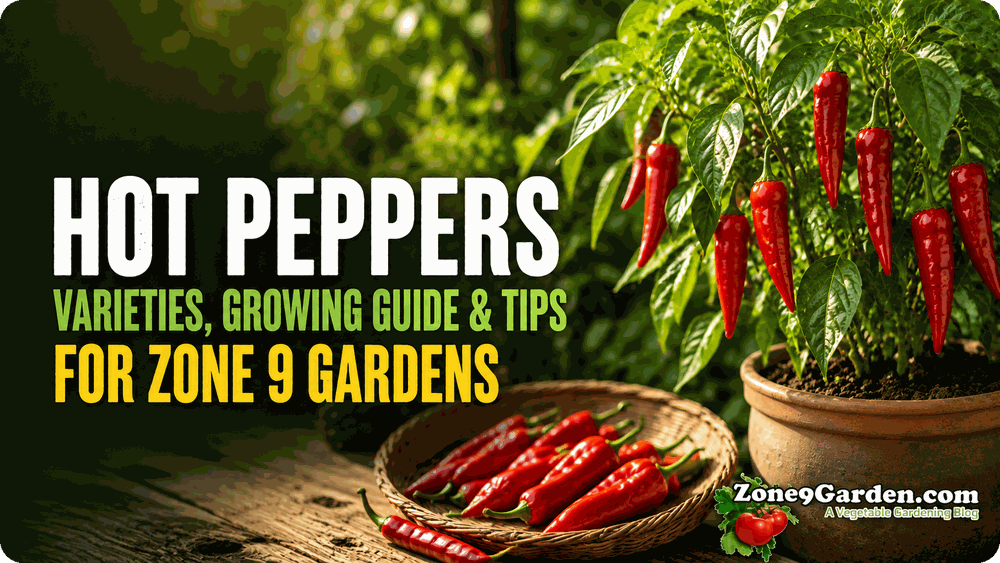
Hot Peppers
Hot peppers are warm-season, frost-sensitive members of the Solanaceae, or nightshade family. They include a wide range of fruit shapes, colors, heat levels, and maturity periods. Common types include jalapeño, serrano, cayenne, Anaheim, Hungarian wax, Tabasco, Thai, and habanero peppers.
UC ANR notes that hot peppers generally have smaller, longer, thinner, and more tapered fruits than sweet peppers and are usually allowed to ripen fully before harvest, except for types such as jalapeños that are commonly harvested green.
Hot peppers benefit from Zone 9’s long growing season, but they remain sensitive to frost and extreme heat during flowering. UC ANR gives approximately 75–85°F daytime temperatures and 55–65°F nights as favorable growing conditions.
Full sun, at least 6 hours daily
70–85 days from transplant average
Vegetable / Warm-Season Annual
Planting Windows for Zone 9
| Stage | Spring |
|---|---|
| Start Indoors | Jan 15 – Feb 15 |
| Direct Sow | Mar 15 – Apr 15 |
| Transplant | Mar 15 – Apr 30 |
| Harvest | Jun 1 – Sep 15 |
Recommended Hot Pepper Varieties
Jalapeño — One of the most widely grown hot peppers. Texas A&M specifically recommends jalapeño for Texas gardens. Mature green fruit develops a deep, dark-green sheen and may also be allowed to ripen red.
TAM Mild Jalapeño — Texas A&M-developed jalapeño type offering traditional jalapeño flavor with reduced heat.
Hidalgo Serrano — Productive serrano pepper specifically recommended by Texas A&M.
Hungarian Wax — Productive hot wax pepper recommended by Texas A&M; fruit may be harvested yellow, orange, or red depending on maturity.
Cayenne — Long, slender hot pepper useful fresh or dried; UC ANR lists maturity around 70–73 days.
Anaheim — Mild hot pepper traditionally used for roasting and chile rellenos; UC ANR lists approximately 75 days to maturity.
Serrano — Small, narrow, moderately hot pepper that may be harvested green or red; UC ANR lists roughly 75 days to maturity.
Tabasco — Small, slender, pointed hot pepper traditionally allowed to mature fully; UC ANR lists about 80 days to maturity.
Thai — Small, very pungent pepper that dries readily; UC ANR lists approximately 70 days to maturity.
Habanero — Very hot, fruity pepper with a longer maturity period, typically around 90–100 days according to UC ANR.
Fertilizer Schedule
Incorporate compost or other organic matter and apply balanced fertilizer according to a soil test.
Apply a starter fertilizer if needed. Texas A&M recommends approximately 2–3 pounds of a fertilizer such as 10-10-10 per 100 square feet where soil-test guidance is unavailable.
Begin light supplemental feeding when the first blossoms appear. UC ANR recommends aged compost or a low-nitrogen fertilizer at this stage.
Apply a second light feeding if needed.
Light feeding every 2–4 weeks if needed can support extended production. Avoid excessive nitrogen, which can produce large leafy plants with poor fruit production.
Planting Details
0.5 inches
18 inches
36 inches
10–14 days
75–85°F
55–60°F
75–80°F for germination; about 65°F+ for transplant establishment
Growing Requirements
Full sun, at least 6 hours daily
Consistent, deep watering
Deep, fertile, well-drained soil rich in organic matter
6.0–6.5
Moderate-to-heavy feeder; avoid excessive nitrogen
Preplant compost and balanced fertilizer → starter fertilizer at transplanting if needed → light feeding when the first flowers open → feed again approximately 3 weeks later → continue light feeding approximately every 2–4 weeks during heavy production if needed.
Top 5 Common Hot Pepper Pests
Small green, pink, brown, or reddish insects cluster on leaf undersides and young growth. Symptoms include curled or distorted leaves, yellowing, reduced vigor, sticky honeydew, and possible transmission of pepper viruses. Texas A&M specifically lists aphids as a common pepper pest.
Buds or developing peppers may yellow and drop prematurely. Fruit can become misshapen and develop holes or discoloration. Larvae and pupae feed inside the fruit. UC ANR identifies fruit drop, misshapen pods, and feeding holes as key symptoms.
Leaves become curled, puckered, scarred, or distorted. Flowers and young fruit may be injured. Thrips are also important because they can transmit Tomato Spotted Wilt Virus.
Caterpillars chew irregular holes in foliage and fruit. Young larvae may skeletonize leaves, while larger larvae can cause substantial defoliation and fruit injury.
Adults and nymphs feed on leaf undersides, producing yellowing, weakening, sticky honeydew, and sometimes sooty mold. Whiteflies can also transmit viral diseases.
Top 5 Common Hot Pepper Diseases
Water-soaked leaf spots become tan or brown, often with a greasy appearance. Severe infection causes premature leaf drop. Fruit may develop dark, raised, wart-like or scabby lesions. UF/IFAS calls bacterial spot the most common and serious foliar disease of peppers in Florida and notes that warm weather, wind-driven rain, and nights above approximately 65°F favor severe infection.
Fruit first develops soft, water-soaked, slightly sunken lesions. As the disease progresses, lesions may develop salmon-colored or gelatinous spore masses. UF/IFAS reports optimum disease development around 80°F, with rainfall increasing spread.
Plants suddenly wilt and may die. Dark lesions develop on stems, crowns, or roots. Fruit may develop water-soaked rot. The disease is strongly associated with excessive irrigation, heavy rainfall, poorly drained soil, and standing water.
Leaves may develop bronzing, necrotic spots, rings, or distortion. Plants can become severely stunted, while fruit may develop irregular rings and blotches. Thrips transmit the virus.
Leaves develop light-and-dark-green mottling, narrowing, curling, or distortion. Plants may become stunted and produce malformed or poorly colored peppers. Aphids transmit several important pepper mosaic viruses.
Zone 9 Weather Patterns
Frost can severely injure or kill hot pepper plants.
Growth and fruit development slow.
Favorable nighttime range.
Favorable daytime range.
Increasing heat can reduce pollen viability and cause flower abortion, especially when nights remain hot.
Pollination, fruit set, and yield may decline substantially.
Greater risk of wilting, flower drop, fruit sunscald, and blossom-end rot.
Greater bacterial spot, anthracnose, Phytophthora, and fruit-rot pressure.
Greater risk of blossom-end rot and inconsistent fruit development.
UC ANR states that peppers prefer approximately 75–85°F days and 55–65°F nights, and that fruit set and yield decline as daytime temperatures approach 100°F. Other UC guidance notes that nights above 70°F and days above 85°F can cause pollen problems and flower abortion.
Harvest
Days to Maturity: 70–85 days from transplant average
Harvest Window:
Spring: June 1 – September 15
Fall: October 1 – December 15
Harvest Indicators:
Most hot peppers can be harvested once they have reached their expected mature size and color. Jalapeños are commonly harvested when full-sized with a deep, dark-green sheen. Other hot peppers are frequently allowed to ripen to yellow, orange, or red for maximum maturity.
Harvest Instructions:
Cut peppers from the plant rather than pulling them to avoid breaking branches. Hot peppers intended for drying should generally be allowed to mature fully on the plant. UC ANR recommends cutting ripe hot peppers with approximately 1 inch of stem attached before drying.
Crop Relationships
Solanaceae — Nightshade Family
Solanaceae / Fruiting Vegetable
Onions
Sweet Alyssum
Marigolds
Calendula
These are best treated as beneficial/insectary companions rather than guaranteed pest-control plants.
Tomatoes
Bell Peppers
Eggplant
Potatoes
These are primarily crop-rotation avoids because they share the Solanaceae family and many of the same diseases and pests.
Sweet peppers when saving seed: Hot and sweet peppers can grow near each other without changing the flavor or heat of the current crop, but peppers cross-pollinate readily. UC ANR advises separating varieties when saving seed because cross-pollination can affect the next generation.
Helpful Links
Sowing Pepper Seeds
— Learn how to start pepper seeds indoors and provide the warm conditions they need for reliable germination.
Make Hot Peppers Hotter
— Learn how growing conditions, watering, and fertilization can help encourage your pepper plants to produce hotter peppers.
Zone 9 Spring Planting Guide
— Use the spring planting calendar to plan hot peppers and other warm-season vegetables.
Zone 9 Fall Planting Guide
— Plan peppers and other vegetables for Zone 9’s productive fall growing season.
15 Heat-Tolerant Vegetables That Thrive in Zone 9 Summers
— See why hot peppers are among the most useful warm-season crops for Zone 9 gardens.
| Data Sources & Methodology: The crop data presented in this guide represents standardized Zone 9 values derived from and averaged across guidance from UF/IFAS Extension, Texas A&M AgriLife Extension, University of Arizona Cooperative Extension, and UC Agriculture & Natural Resources. USDA establishes the Zone 9 plant-hardiness framework. Recommendations may vary by local climate, cultivar, soil conditions, microclimate, and individual growing conditions. |
| UF/IFAS Extension • Texas A&M AgriLife Extension • University of Arizona Cooperative Extension • UC Agriculture & Natural Resources • USDA Plant Hardiness Zone Map |