
Kale
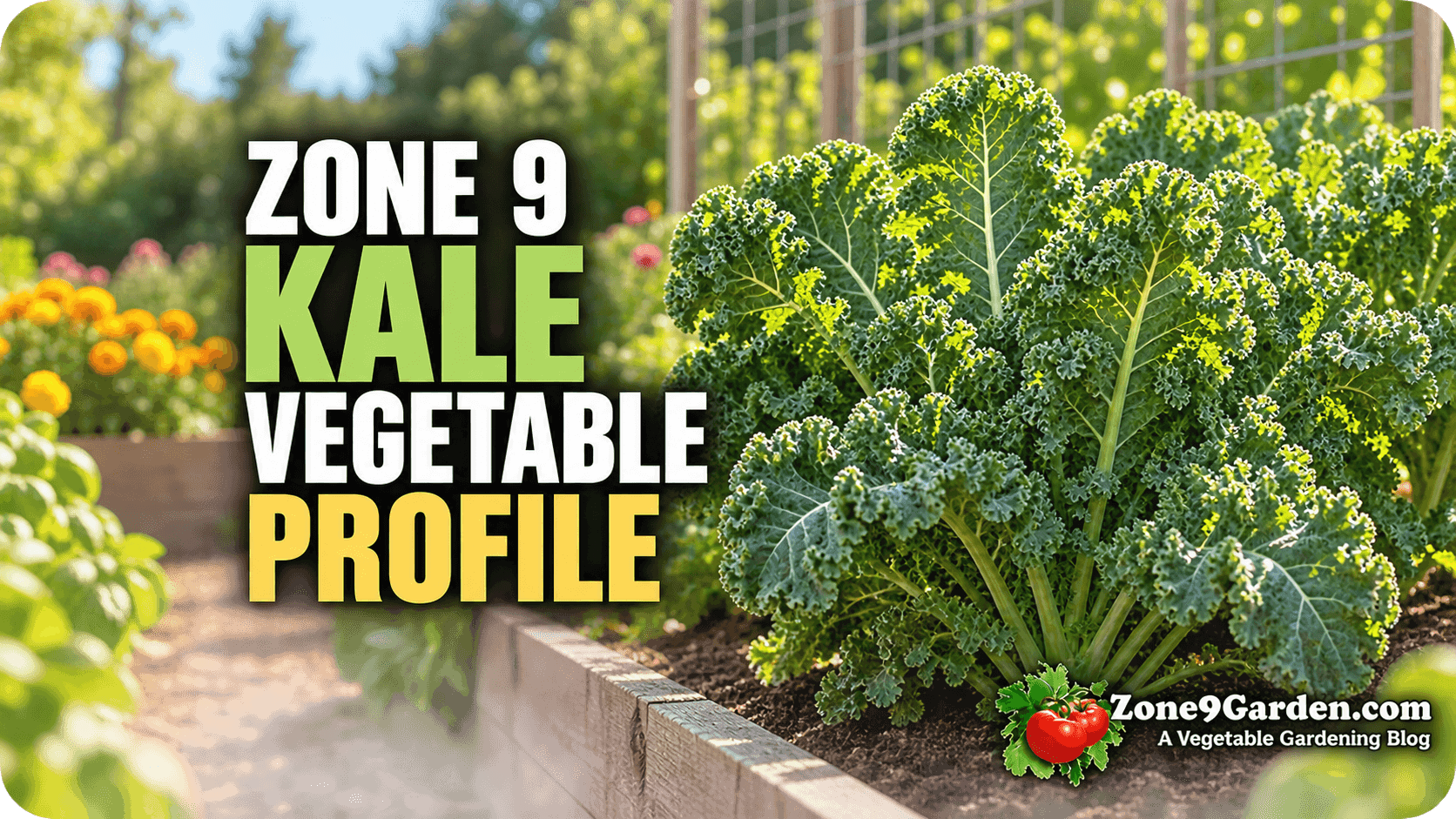
Kale is a hardy, cool-season leafy vegetable in the Brassicaceae, or mustard/cabbage family. Unlike cabbage, kale does not form a head; it produces an open rosette of leaves that may be curly, flat, blue-green, or purple depending on cultivar. Kale is highly cold tolerant, and leaf flavor and tenderness generally improve during cool weather.
Zone 9 is especially well suited to fall, winter, and early-spring kale production. UF/IFAS lists kale from August through February in North Florida, September through February in Central Florida, and September through January in South Florida. Arizona Extension recommends kale when soils are about 45–85°F and daytime temperatures are roughly 60–75°F, and notes that established kale tolerates cold well.
Planting Windows for Zone 9
| Stage | Spring | Fall |
|---|---|---|
| Start Indoors | Dec 15 – Jan 31 | Jul 15 – Aug 31 |
| Direct Sow | Jan 15 – Feb 28 | Aug 15 – Nov 15 |
| Transplant | Feb 15 – Mar 31 | Sep 1 – Nov 30 |
| Harvest | Mar 15 – May 31 | Oct 1 – Mar 31 |
Recommended Kale Varieties
Blue Ridge — Hybrid kale recommended by UF/IFAS for Florida production.
Darkibor — Curly hybrid kale recommended by UF/IFAS; vigorous with dark blue-green leaves.
Oldenbor — Curly hybrid kale recommended by UF/IFAS.
Starbor — Compact curly hybrid kale recommended by UF/IFAS.
Vates — Open-pollinated kale recommended by UF/IFAS; compact and cold tolerant.
Winterbor — Curly hybrid kale recommended by UF/IFAS; noted for strong cold tolerance and extended harvest.
Dinosaur (Lacinato type) — Recommended in Texas A&M planting guidance; long, dark, blistered leaves with good cool-season quality.
Fertilizer Schedule
Incorporate finished compost or organic matter and apply fertilizer according to a soil test. If fertility is low and no test is available, use a modest balanced fertilizer before planting.
Set transplants at the same depth they were growing and water thoroughly. Use starter fertilizer only if needed and avoid concentrated fertilizer directly against roots or stems.
Apply a light nitrogen side-dressing to support dark-green leafy growth.
Repeat a light side-dressing only if plants become pale or growth slows and insect damage is not responsible.
Routine heavy feeding is unnecessary in well-prepared soil. Use only light supplemental fertilizer where prolonged harvest, sandy soil, or nutrient-leaching rainfall indicates a need.
Planting Details
0.25–0.5 inches
8–12 inches
18–24 inches
4–7 days under favorable conditions
65–70°F optimum; 45–85°F workable planting range
45°F practical lower planting and germination limit
65–70°F excellent germination and establishment target
Growing Requirements
Full sun, 6–8+ hours daily; tolerates some light partial shade
Consistent, deep watering; keep soil evenly moist without waterlogging, especially during rapid leaf production.
Fertile, well-drained loam or sandy loam rich in organic matter; avoid compacted or poorly drained soil.
6.0–6.5
Moderate-to-heavy nitrogen feeder for leafy growth; maintain balanced fertility and avoid excessive late applications.
Preplant compost/soil-test fertilizer → starter fertilizer at transplanting if needed → light nitrogen side-dressing after thinning or once transplants are established → repeat in about 4–6 weeks only if plants become pale or growth slows → additional light feeding only if prolonged harvest, sandy soil, or nutrient-leaching rainfall indicates a need.
Top 5 Common Kale Pests
Fall–Spring; active during mild weather
Velvety green caterpillars chew large irregular holes in leaves and may skeletonize foliage when numerous. Frass and caterpillars reduce the quality of harvested leaves.
Fall–Spring
Green looping caterpillars chew ragged holes in leaves. Heavy populations can remove substantial leaf area and reduce harvest quality.
Fall–Spring; often strongest during mild weather
Small green larvae feed mainly on leaf undersides, first creating translucent window-like patches and later small holes. Heavy infestations can leave foliage riddled with feeding damage.
Fall–Spring; often increases during cool mild weather
Dense gray-green aphid colonies form on young leaves and stems. Feeding causes curling, yellowing, stunting, and contamination of harvested foliage.
Fall–Spring; greatest on seedlings and young transplants
Adults chew numerous small round shot holes in leaves. Heavy feeding can stunt or severely weaken young plants before they become established.
Top 5 Common Kale Diseases
Warm, wet or humid conditions
Yellow V-shaped lesions develop from leaf margins toward the midrib and veins may darken. Severe infection causes leaf death, stunting, and systemic vascular discoloration.
Cool-to-moderate moist soil; especially acidic or infested soil
Roots become enlarged, swollen, and club-shaped. Aboveground plants are stunted, yellow, and may wilt during warm parts of the day despite adequate soil moisture.
Cool, humid or wet weather; Fall–Spring
Irregular pale-yellow patches develop on upper leaf surfaces and white to gray fluffy growth can appear underneath. Severe infection causes browning, blighting, and loss of usable foliage.
Mild-to-warm humid weather with prolonged leaf wetness
Small dark circular spots enlarge and often develop concentric target-like rings. Severe infection causes leaf blighting and lowers the quality of harvested greens.
Cool, moist weather; often Fall–Spring
White raised pustules develop mainly on leaf undersides, while yellow spots may appear on upper surfaces. Heavy infection can distort leaves and reduce marketable or usable foliage.
Zone 9 Weather Patterns
Kale is highly adapted to the cooler part of the Zone 9 growing season, with cool weather generally improving leaf sweetness and tenderness.
Young kale may be injured, but established plants are highly cold tolerant and often survive light freezes.
Established kale tolerates frost well, and cool weather often improves sweetness and tenderness.
Practical lower planting/germination limit used in Arizona guidance.
Broad workable planting range in Arizona Extension guidance.
Excellent seed-germination target; UC ANR lists 65–70°F for kale germination.
Favorable cool-season growth range.
Growth can continue, but leaves may become tougher or more bitter and insect pressure can increase.
Greater risk of wilting, tough leaves, slower tender growth, and increased insect pressure.
Greater risk of downy mildew, black rot, clubroot, Alternaria leaf spot, and white rust.
Can reduce leaf quality and cause uneven growth; maintain consistent moisture for steady production.
Harvest
50 days
Spring: March 15 – May 31
Fall/Winter: October 1 – March 31
Leaves are full-sized for the intended use, deep green or cultivar-appropriate in color, tender, and free of major yellowing or toughness. Individual outer leaves can be harvested once they reach usable size while the center continues growing. Cool weather often improves sweetness and tenderness.
Harvest the largest lower leaves first, leaving the central growing point and several younger leaves intact for continued production. Cut leaves cleanly near the stem. Baby leaves can be harvested young, while mature leaves are best picked before they become overly tough or yellow.
Crop Relationships
Brassicaceae — Mustard / Cabbage Family
Brassicaceae / Cole Crops
Sweet Alyssum
Dill
Cilantro
Calendula
Marigolds
Cabbage
Broccoli
Cauliflower
Collard Greens
Brussels Sprouts
Helpful Links
- Zone 9 Planting Calendar: What to Plant All Year — Use the year-round planting calendar to plan kale alongside other cool-season Zone 9 vegetables.
- Zone 9 Fall Planting Guide — See when kale and other cool-season vegetables fit into the Zone 9 fall garden.
- What to Plant in September in Zone 9 — Learn how kale fits into the transition from summer heat to fall production.
- Zone 9 Winter Planting Guide — Plan kale and other cold-tolerant vegetables for the productive Zone 9 winter season.
- Transition Your Garden From Summer Heat to Fall Production — Prepare beds and rotate crops before planting kale and other fall vegetables.
The crop data presented in this guide represents standardized Zone 9 values derived from and averaged across guidance from UF/IFAS Extension, Texas A&M AgriLife Extension, University of Arizona Cooperative Extension, and UC Agriculture & Natural Resources. USDA establishes the Zone 9 plant-hardiness framework. Recommendations may vary by local climate, cultivar, soil conditions, microclimate, and individual growing conditions.