
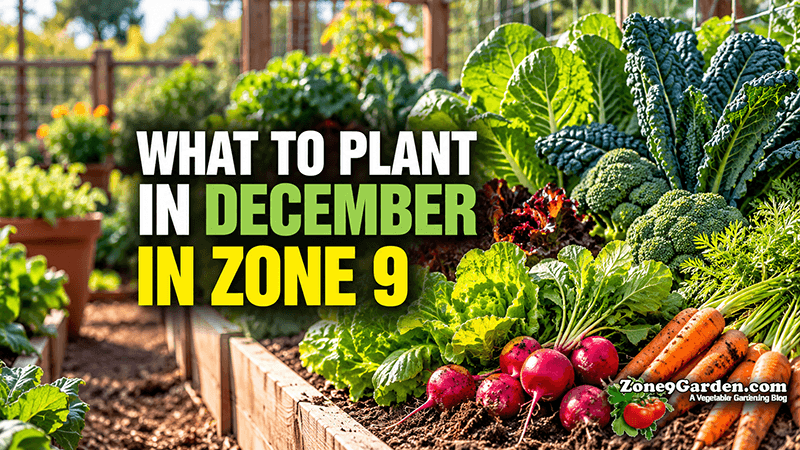
December is one of the best months to grow vegetables in Zone 9.
While gardeners in colder parts of the country are putting their gardens to bed for winter, many Zone 9 gardeners are entering one of the most productive growing periods of the year.
Cooler temperatures, shorter days, and reduced heat stress create excellent conditions for vegetables that struggled during summer.
Lettuce, spinach, carrots, radishes, beets, kale, collard greens, and peas can all thrive during the Zone 9 winter growing season.
December is also an important month for harvesting broccoli, cabbage, cauliflower, and other vegetables established during fall.

For many Zone 9 gardeners, December isn’t the end of the gardening season.
It’s the beginning of prime winter vegetable gardening.
However, exactly what you should plant depends on where you live.
Zone 9 includes parts of Florida, Texas, Louisiana, Arizona, and California. A gardener in humid Central Florida may experience very different December conditions from someone gardening in the dry Arizona desert or California’s inland valleys.
USDA hardiness zones describe average annual extreme minimum temperatures. They don’t provide a complete vegetable planting calendar.
Use this guide as your December starting point, then adjust your planting schedule based on local temperatures, frost dates, and growing conditions.
For a complete overview of the winter season, visit our Zone 9 Winter Planting Guide.
What Can You Plant in December in Zone 9?
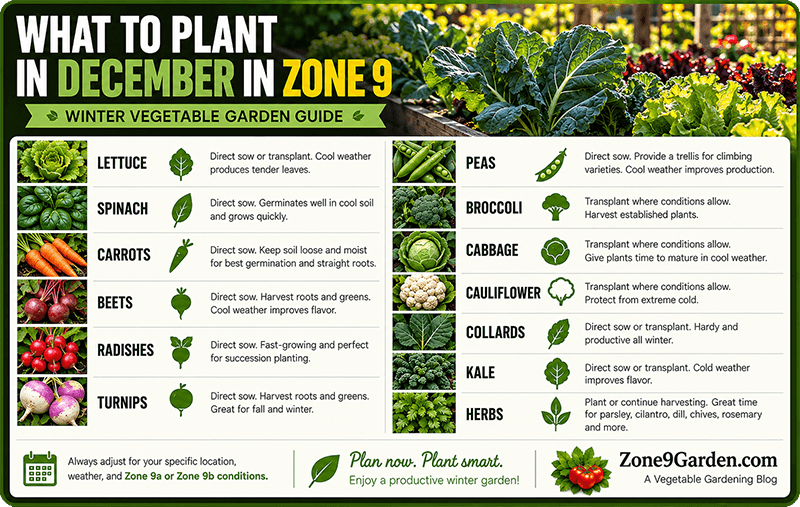
December is primarily a cool-season vegetable planting month.
Leafy greens, root vegetables, and certain members of the cabbage family are particularly well suited to winter conditions.
Some crops should be direct sown, while others perform better when established as transplants.
Here’s a quick starting point.
December Zone 9 Planting Calendar
| Crop | December Planting Strategy | December Harvest |
|---|---|---|
| Lettuce | Direct sow or transplant | Harvest established plants |
| Spinach | Direct sow | Harvest established plants |
| Carrots | Direct sow | Harvest earlier plantings |
| Radishes | Direct sow | Harvest mature roots |
| Beets | Direct sow | Harvest roots and greens |
| Kale | Direct sow or transplant | Harvest outer leaves |
| Collard Greens | Direct sow or transplant | Harvest outer leaves |
| Peas | Direct sow | Harvest established plantings |
| Broccoli | Transplant where conditions allow | Harvest mature heads |
| Cabbage | Transplant where conditions allow | Harvest mature heads |
Harvest Note: December harvests generally come from vegetables planted during October, November, or earlier. Crops planted in December will usually require additional growing time before they’re ready to pick.
These recommendations follow our Zone 9 Winter Planting Guide.
They aren’t universal planting dates.
Gardeners in warmer parts of Zone 9 may have excellent conditions for starting new vegetables throughout December.
Gardeners in colder Zone 9a locations may be better off concentrating on established fall crops while planting smaller amounts of frost-tolerant vegetables.
Think of December as the month when your cool-season garden becomes the main attraction.
Lettuce and Leafy Greens
December is an excellent month for growing leafy greens in Zone 9.
Lettuce, spinach, kale, and collard greens generally perform much better during cool weather than during the intense heat of summer.
Shorter days may slow growth, but cooler temperatures also reduce the risk of heat-related bolting.
Lettuce
Lettuce is one of the best vegetables to plant in December.
Cool weather encourages tender leaves and makes it easier to grow varieties that might struggle during summer.
Both leaf lettuce and heading varieties can perform well, although their growing requirements differ.
Leaf lettuce is particularly useful for gardeners who want repeated small harvests.
Instead of planting an entire bed at once, sow a short row every week or two.
This can provide fresh lettuce over a longer period rather than having everything mature simultaneously.
You can also transplant healthy lettuce seedlings into prepared garden beds.
Keep the soil consistently moist during establishment, but avoid waterlogged conditions.
For more information, read our How to Grow Lettuce in Zone 9 guide.
Spinach
Spinach deserves a place in nearly every Zone 9 winter garden.
Unlike many warm-season vegetables, spinach prefers cool temperatures.
December often provides the conditions it needs to grow healthy, tender leaves.
Direct sow spinach seeds into well-prepared soil.
Keep the seedbed evenly moist during germination.
Avoid overcrowding seedlings, and harvest leaves once plants are large enough.
Spinach can also be planted in smaller batches to extend the harvest.
However, don’t assume that every December planting will mature quickly.
Cold temperatures and shorter daylight hours can slow growth considerably.
Kale
Kale is another excellent December vegetable.
Established kale plants tolerate light frost and can continue producing leaves throughout much of winter.
Depending on the variety and local conditions, kale can be grown from seed or transplants.
Give plants enough room to mature.
Once established, harvest the largest outer leaves while leaving the central growing point intact.
This allows plants to continue producing new foliage.
For detailed planting and harvesting instructions, see our Zone 9 Kale Growing Guide.
Collard Greens
Collard greens are particularly well suited to Zone 9 winter gardening.
They tolerate cool weather, produce large nutritious leaves, and can provide repeated harvests over several months.
December is an excellent time to harvest established collard plants.
In many warmer Zone 9 locations, gardeners can also direct sow seeds or transplant young collards.
Choose healthy seedlings and maintain consistent moisture during establishment.
Harvest mature outer leaves regularly while allowing the center of the plant to continue growing.
For more detailed advice, visit our How to Grow Collard Greens in Zone 9 guide.
Carrots and Beets
December is one of the best times to grow root vegetables in many Zone 9 gardens.
Carrots and beets appreciate cooler temperatures, and both can produce excellent winter harvests.
However, soil preparation is especially important.
Unlike leafy vegetables, root crops need enough space underground to develop properly.
Carrots
Carrots are an excellent choice for December planting.
Cool growing conditions can encourage good root quality and sweetness.
However, carrots are less forgiving of poorly prepared soil than many other vegetables.
Before planting, remove rocks, hard clods, and other obstructions.
Loose, well-drained soil allows roots to develop more evenly.
Direct sow carrot seeds rather than transplanting seedlings.
Carrot seeds are small and planted relatively shallowly, making consistent surface moisture particularly important.
Don’t allow the upper layer of soil to repeatedly dry out during germination.
Once seedlings emerge, thin them to provide enough space for developing roots.
For detailed instructions, read our How to Grow Carrots in Zone 9 guide.
Beets
Beets are another dependable December crop.
One advantage of growing beets is that they provide two edible harvests.
The roots are the main crop, but the leaves can also be harvested as beet greens.
Direct sow beet seeds into prepared soil.
Because beet seed clusters can produce multiple seedlings, thinning is particularly important.
Crowded plants may develop smaller roots.
Beets can also be succession planted.
Sow a short row in early December and another later in the month if local conditions remain favorable.
This can spread your harvest across several weeks.
See our How to Grow Beets in Zone 9 guide for planting depth, spacing, fertilizing, and harvesting information.
Radishes: One of the Best Quick December Crops
If you’re looking for a fast-growing winter vegetable, radishes should be near the top of your list.
Radishes are particularly useful during December because they require relatively little garden space and many varieties mature quickly.
They can be grown in traditional rows, raised beds, or containers.
Direct sow radish seeds into loose, well-drained soil.
Thin seedlings when necessary so developing roots have enough room.
Don’t overcrowd them.
Crowded radishes may produce plenty of leaves without developing good-sized roots.
December is also a great month for succession planting.
Instead of sowing an entire packet at once, plant a short row and then sow another one a week or two later.
This provides a more manageable harvest.
Some radish varieties may be ready in approximately three to five weeks under favorable conditions, although cold winter weather can slow maturity.
For additional growing advice, visit our How to Grow Radishes in Zone 9 resources.
Peas: A Great December Planting Choice
December can be one of the best months to grow peas in Zone 9.
English peas, sugar snap peas, and snow peas all prefer cool growing conditions.
They often struggle when spring temperatures become too warm, making fall and winter planting especially valuable.
For December planting, consider varieties such as:
- Sugar Ann — an early-maturing sugar snap pea.
- Oregon Sugar Pod II — a productive snow pea with tender edible pods.
- Little Marvel — a compact English shelling pea.
- Wando — an English pea with better heat tolerance than many traditional varieties.
Direct sow peas into well-drained soil.
Most climbing varieties need a trellis or another support structure.
Install the support before planting or while plants are still small.
Peas generally need consistent moisture, particularly during flowering and pod development.
However, they don’t tolerate constantly saturated soil.
December plantings may take longer to mature than the seed packet suggests because winter days are shorter and temperatures are cooler.
The goal is to establish plants early enough for flowering and pod development to occur before sustained spring heat.
For a complete guide, see How to Grow Peas in Zone 9.
Broccoli, Cabbage, and Cauliflower
December is an important month for the cabbage family.
Broccoli, cabbage, and cauliflower appreciate cool weather, but they generally require more growing time than quick crops such as radishes and leaf lettuce.
For this reason, many Zone 9 gardeners establish these vegetables during September, October, or November.
By December, those fall plantings may be developing heads or approaching harvest.
Broccoli
Broccoli performs well during cool weather.
Established plants may produce large central heads during December, depending on when they were planted.
Some varieties also produce smaller side shoots after the main head is harvested.
Healthy broccoli transplants may still be planted during December where enough favorable growing weather remains.
However, gardeners should consider the variety’s maturity period and expected winter conditions.
Don’t assume that a small December transplant will produce a harvest immediately.
For more information, read our How to Grow Broccoli in Zone 9 resources.
Cabbage
Cabbage is another excellent winter vegetable.
It needs consistent growth to develop firm, well-formed heads.
December is a good time to monitor established plants for head development.
Some gardeners may also transplant cabbage during December, particularly in milder locations.
Give cabbage plants adequate spacing.
A small transplant may not look like it needs much room, but mature plants can become surprisingly large.
Protect young plants when unusually severe freezing weather is expected.
Cauliflower
Cauliflower deserves special attention during December.
Like broccoli and cabbage, it prefers cool weather.
However, cauliflower can be more sensitive to temperature fluctuations and stress during head development.
Many Zone 9 gardeners have better results establishing cauliflower during fall and allowing it to mature during winter.
December is often more useful as a growing and harvesting month for established cauliflower than as the ideal time to begin a new planting.
Keep soil moisture consistent and monitor plants closely as heads develop.
What About Onions and Garlic in December?
Onions are included among the valuable cool-season vegetables in our Winter Planting Guide, although they require more variety-specific planning than crops such as lettuce and radishes.
The most important consideration is day length.
Onions form bulbs in response to daylight duration, and choosing the wrong variety can result in disappointing production.
Short-day onions are commonly grown in much of the southern United States.
However, intermediate-day varieties may be more appropriate in some other Zone 9 regions.
Choose onion varieties recommended by your local Extension service.
December may be a suitable time to establish onion transplants in some Zone 9 locations.
Garlic is another crop that may already be growing during December.
Many gardeners plant garlic during fall so it can establish roots during the cooler months.
December garlic planting suitability varies considerably by region, variety, and the chilling conditions available.
For the best results, follow local planting recommendations rather than assuming that every Zone 9 location has the same garlic-growing season.
What About the Summer Garden?
By December, most Zone 9 gardens have transitioned away from summer vegetables.
However, that doesn’t mean every warm-season plant must be removed.
In some frost-free or nearly frost-free locations, healthy peppers, tomatoes, and other warm-season vegetables may still be producing.
Look at the plants and your local forecast rather than relying only on the calendar.
If a pepper plant is healthy and producing, it may be worth keeping.
However, tomatoes, peppers, eggplants, and many other warm-season crops can suffer serious damage during freezing weather.
Gardeners in colder Zone 9 locations should expect greater frost risk.
Don’t allow exhausted summer plants to occupy valuable space needed for productive winter vegetables.
Remove plants that are severely diseased, badly stressed, or no longer producing worthwhile harvests.
Then prepare those beds for crops that are better suited to December conditions.
December Herbs for Zone 9
December isn’t just about vegetables.
Several herbs perform particularly well during cool weather.
Cilantro and parsley are especially useful additions to a Zone 9 winter garden.
Cilantro often struggles during hot weather because it can bolt quickly.
Cool December temperatures can make it much easier to grow.
Parsley also performs well in mild winter conditions.
Depending on your location, consider growing:
- Cilantro
- Parsley
- Dill
- Chives
- Rosemary
- Mint
Established rosemary may continue growing during mild weather.
Mint can also remain productive in warmer locations, although cold weather may slow or temporarily stop growth.
Chives and other perennial herbs may grow slowly during winter.
Avoid assuming that warm-season herbs such as basil will tolerate freezing conditions.
Basil is particularly sensitive to cold.
Keep Succession Planting Through December
December isn’t a one-week planting season.
You don’t need to plant every seed on the same day.
In fact, succession planting can make your winter garden much more productive.
Instead of having every vegetable mature simultaneously, spread your plantings across several weeks.
This works particularly well with:
- Lettuce
- Radishes
- Carrots
- Beets
- Spinach
- Peas
For fast-growing vegetables such as radishes and leaf lettuce, consider planting a small amount every one or two weeks.
For carrots, beets, and peas, two- or three-week intervals may be more practical.
However, succession planting must account for local weather.
In colder Zone 9 locations, new seedlings may establish slowly during December.
In warmer locations, later plantings may mature more quickly as spring approaches.
The goal isn’t to plant continuously without considering conditions.
It’s to spread your harvest across the cool season.
Learn more in our Succession Planting in Zone 9 guide.
Prepare Your Garden for Winter Growing
If your garden isn’t fully established by December, there’s still time to prepare additional growing space.
Start by removing weeds and exhausted plants.
Don’t leave heavily diseased plant material in the garden where it may contribute to future problems.
Then prepare the soil for your winter crops.
Consider the following tasks:
- Remove old plants and weeds.
- Add finished compost where additional organic matter is needed.
- Check soil drainage before planting.
- Loosen compacted soil for root vegetables.
- Inspect irrigation lines and repair leaks.
- Replenish mulch around established plants.
- Install trellises for climbing peas.
- Make room for succession plantings.
- Check established vegetables for insects and disease.
- Keep frost cloth available for cold weather.
Avoid adding large amounts of fertilizer automatically.
Different vegetables have different nutrient requirements.
Leafy greens and brassicas often need more nitrogen than peas, while root vegetables can suffer from excessive nitrogen applications.
A soil test can help determine what your garden actually needs.
December Watering in Zone 9
December watering is different from summer watering.
Cooler temperatures, shorter days, and reduced evaporation often mean your garden uses less water.
However, that doesn’t mean you can ignore irrigation.
Newly planted seeds still need consistent moisture during germination.
Carrots, lettuce, spinach, radishes, and other directly sown vegetables are particularly vulnerable when the seedbed repeatedly dries out.
Young transplants also need adequate moisture while their roots become established.
Once plants are growing well, water according to actual soil conditions.
Don’t continue using the same irrigation schedule you followed during July or August.
Overwatering during cool weather can create problems.
Saturated soil reduces oxygen around plant roots and can encourage root diseases.
Check the soil before watering.
If it’s still adequately moist, wait.
Rainfall varies considerably across Zone 9.
Florida gardens may experience very different winter moisture conditions from Arizona or inland California gardens.
Your irrigation schedule should reflect your garden’s soil and weather.
Protect Your December Garden From Frost
Frost protection becomes increasingly important during December.
Although Zone 9 is known for relatively mild winters, freezing temperatures can still occur.
USDA Zone 9a has an average annual extreme minimum temperature of 20–25°F, while Zone 9b ranges from 25–30°F.
Those temperatures are cold enough to damage many vegetables.
However, not every winter vegetable responds to frost the same way.
Established kale and collards generally tolerate light frost well.
Lettuce, broccoli, cabbage, and young transplants may require additional protection during unusually severe cold.
Even frost-tolerant vegetables can be damaged by prolonged freezing temperatures.
How to Protect Vegetables During a Freeze
When freezing weather is expected:
- Check the forecast for both temperature and duration.
- Water dry soil appropriately before the freeze, but avoid waterlogging.
- Cover vulnerable plants with frost cloth.
- Secure covers so cold wind cannot lift them.
- Keep fabric from crushing tender plants by using supports where necessary.
- Remove or ventilate covers when temperatures rise and protection is no longer needed.
- Inspect plants after the freeze before removing damaged foliage.
Avoid placing plastic directly against leaves during freezing weather.
Plastic touching foliage can contribute to cold injury.
For additional winter protection advice, see our Zone 9 Winter Planting Guide.
Watch for December Garden Pests
Cooler temperatures don’t mean garden pests disappear.
In many Zone 9 locations, insects remain active throughout winter.
Broccoli, cabbage, cauliflower, kale, and collards can attract caterpillars capable of causing significant leaf damage.
Common pests to watch for include:
- Cabbage loopers
- Imported cabbageworms
- Diamondback moth larvae
- Aphids
- Slugs and snails
- Leafminers
Inspect the undersides of leaves regularly.
Small caterpillars can be difficult to notice until their feeding damage becomes obvious.
Aphids may gather on tender new growth or in developing broccoli heads.
Slugs and snails can become troublesome during damp winter weather.
Disease problems also remain possible.
Cool, humid conditions can favor downy mildew and certain leaf diseases, while saturated soil may encourage root rot.
Maintain appropriate spacing, avoid unnecessary leaf wetness, and remove severely diseased material.
Regular inspection is one of the easiest ways to prevent small problems from becoming serious ones.
Zone 9a vs. Zone 9b in December
December is one of the months when differences between Zone 9 gardens become especially important.
Both Zone 9a and Zone 9b support winter vegetable gardening, but freezing temperatures, rainfall, and daytime growing conditions can vary considerably.
Zone 9a Gardens
Zone 9a gardeners generally experience colder winter extremes.
In some locations, December may bring repeated frost events or occasional hard freezes.
Established collards, kale, and other hardy vegetables can continue growing, although growth may slow.
Young transplants may need additional protection.
Long-season vegetables such as broccoli, cabbage, and cauliflower are often more dependable when established during fall rather than started late in December.
Zone 9b Gardens
Zone 9b generally experiences milder winter extremes.
Many locations provide favorable December conditions for direct sowing leafy greens, carrots, radishes, beets, and peas.
However, Zone 9b doesn’t mean frost-free.
Freezing weather can still occur, particularly during unusual cold outbreaks.
Keep protection available for vulnerable crops.
Your Local Weather Matters More Than the Zone Number
A Zone 9a garden in California may experience very different conditions from a Zone 9a garden in Texas.
Likewise, Zone 9b gardens in Florida and Arizona can have very different rainfall, humidity, and soil conditions.
Consider your local frost dates, current temperatures, soil moisture, and expected weather before planting.
Use your hardiness zone as a starting point.
Let your local conditions determine the final planting schedule.
Regional December Planting Considerations
Florida and the Southeast
December is often an excellent vegetable-growing month in Florida.
Lettuce, spinach, carrots, radishes, beets, kale, collards, and peas are valuable cool-season choices.
Humidity and rainfall can still contribute to disease problems.
Good drainage and regular plant inspection are important.
Texas and the Gulf Coast
December can provide excellent cool-season growing conditions, but temperatures may change rapidly.
Warm periods can be followed by freezing weather.
Keep frost protection available and choose planting dates that allow young plants to establish before severe cold.
Arizona
Arizona’s winter conditions vary greatly with elevation.
Low-desert locations may provide excellent growing conditions for peas, lettuce, carrots, and other cool-season vegetables.
However, dry air and rapid soil moisture loss may require more frequent attention to irrigation.
Higher-elevation locations can experience substantially colder weather.
California
California Zone 9 gardens include coastal-influenced locations and inland valleys.
Some areas have extended periods of mild winter weather.
Others experience cold nights, fog, or prolonged wet conditions.
Drainage and disease management become particularly important during extended damp weather.
Adjust planting and watering schedules to your local climate.
Your December Zone 9 Garden Checklist
If you only have one weekend to work in your garden, focus on the essentials.
Plant now: Direct sow carrots, beets, radishes, spinach, and peas where local conditions are favorable.
Get established: Plant lettuce, kale, and collard greens from seed or transplants as appropriate for your location.
Transplant carefully: Add broccoli or cabbage only where enough cool growing weather remains for successful development.
Keep harvesting: Pick mature lettuce, kale, collards, broccoli, cabbage, carrots, beets, and radishes from established fall plantings.
Succession plant: Sow small amounts of lettuce, radishes, carrots, and other suitable vegetables rather than planting everything at once.
Protect from frost: Keep frost cloth available and monitor nighttime forecasts.
Check watering: Reduce unnecessary irrigation, but maintain moisture around newly planted seeds and young transplants.
Inspect for pests: Check brassica leaves for caterpillars and aphids.
Prepare empty beds: Remove exhausted plants, improve soil where necessary, and make room for additional winter vegetables.
Plan ahead: Review what you want to plant in January and February before purchasing additional seeds.
A few well-timed December tasks can keep your Zone 9 garden productive throughout winter.
Frequently Asked Questions About December Planting in Zone 9
What are the best vegetables to plant in December in Zone 9?
Lettuce, spinach, carrots, radishes, beets, kale, collard greens, and peas are among the best choices.
Broccoli and cabbage transplants may also be suitable where enough cool weather remains.
Is December too late to plant vegetables in Zone 9?
No.
December is an excellent planting month in many Zone 9 gardens.
However, longer-season vegetables may perform better when established during fall.
Can you plant carrots in December in Zone 9?
Yes.
Carrots are a good December crop in many Zone 9 locations.
Direct sow seeds into loose, well-drained soil and maintain consistent moisture during germination.
Can you plant peas in December in Zone 9?
Yes.
December can provide excellent growing conditions for English peas, sugar snap peas, and snow peas.
Choose suitable varieties and provide trellises for climbing types.
Can you plant broccoli in December in Zone 9?
Yes, in some locations.
Healthy transplants may perform well where enough cool weather remains.
However, broccoli established during fall is often more dependable for winter harvesting.
Can you grow lettuce during December in Zone 9?
Yes.
Lettuce is one of the best cool-season vegetables for Zone 9.
Both direct sowing and transplanting can work under favorable conditions.
What can you harvest in December in Zone 9?
Depending on earlier planting dates, gardeners may harvest lettuce, spinach, kale, collards, broccoli, cabbage, carrots, radishes, beets, and peas.
Do I need to protect my Zone 9 garden from frost in December?
Sometimes.
Established frost-tolerant vegetables may handle light freezes, but young plants and tender crops can suffer damage during severe cold.
Monitor local forecasts and protect vulnerable plants when necessary.
Should I fertilize my garden in December?
Only when needed.
Fertilizer requirements depend on the crop, soil conditions, and growth stage.
Avoid applying large amounts of fertilizer automatically during winter.
How often should I water vegetables in December?
Water according to soil moisture, rainfall, and plant needs.
Cooler weather often reduces water requirements, but newly planted seeds still need consistent moisture.
Final Thoughts
December is one of the most productive months for vegetable gardening in Zone 9.
While colder regions are waiting for spring, Zone 9 gardeners can grow fresh lettuce, spinach, carrots, radishes, beets, kale, collards, and peas.
Established broccoli, cabbage, and other fall vegetables may also be ready for harvest.
The key is understanding that December gardening is different from summer gardening.
Shorter days and cooler temperatures slow growth, but they also create favorable conditions for many vegetables that struggle during hot weather.
Focus on cool-season crops, maintain consistent soil moisture, monitor for pests, and prepare for occasional freezing temperatures.
Most importantly, don’t assume your planting season is over simply because December has arrived.
In Zone 9, winter can be one of the best times of the year to grow a vegetable garden.
Related Zone 9 Gardening Guides
- Zone 9 Winter Planting Guide — Complete December, January, and February planting recommendations.
- What to Plant in October in Zone 9 — Prepare your garden for the cool season.
- Zone 9 Fall Planting Guide — Learn how to establish a productive fall garden.
- How to Grow Carrots in Zone 9 — Plant, care for, and harvest winter carrots.
- How to Grow Peas in Zone 9 — Grow English, sugar snap, and snow peas.
- How to Grow Collard Greens in Zone 9 — Enjoy repeated harvests of nutritious winter greens.
- How to Grow Beets in Zone 9 — Grow beets for roots and greens.
- How to Grow Lettuce in Zone 9 — Keep fresh salad greens growing during winter.
- Zone 9 Crop Profiles — Explore individual vegetable-growing guides.
- Succession Planting in Zone 9 — Extend your harvest with staggered planting dates.