
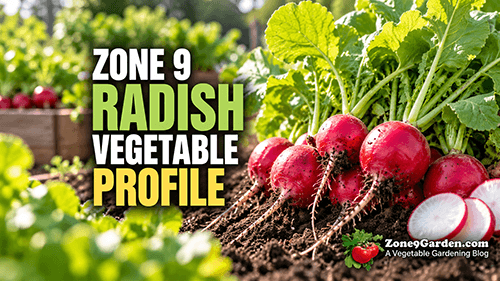
Radish
Radish is a fast-growing, cool-season root vegetable in the Brassicaceae, or mustard/cabbage family. It is grown primarily for its crisp, pungent root, although the leaves are also edible. Radishes perform best in loose, well-drained soil with consistent moisture and cool temperatures. Zone 9 is especially well suited to fall, winter, and early-spring production. UF/IFAS lists radish planting from September through March in North and Central Florida and October through March in South Florida. UC ANR reports best growth at about 50–70°F, while temperatures above about 80°F increase bolting, pithiness, root deformation, and strong flavor.
Planting Windows for Zone 9
| Stage | Spring | Fall |
|---|---|---|
| Start Indoors | Not Recommended | Not Recommended |
| Direct Sow | Jan 1 – Mar 31 | Sep 1 – Dec 31 |
| Transplant | Not Recommended | Not Recommended |
| Harvest | Feb 1 – May 1 | Oct 1 – Mar 31 |
Recommended Radish Varieties
Cherry Belle — Fast-maturing round red radish recommended by UF/IFAS and UC ANR.
White Icicle — Long white radish recommended by UF/IFAS and Texas A&M; useful for cool-season gardens.
Sparkler — Red-and-white globe radish recommended by UF/IFAS and Arizona Extension.
Champion — Round red radish recommended by UF/IFAS, Texas A&M, and Arizona Extension.
Easter Egg — Mixed-color radish recommended by UC ANR and Arizona Extension.
French Breakfast — Elongated red-and-white radish commonly used as a quick spring/fall type.
April Cross — Winter/Asian-type radish recommended by UC ANR.
Daikon — Long white winter radish recommended by UF/IFAS; matures more slowly than standard spring radishes.
Fertilizer Schedule
Incorporate finished compost or organic matter and apply fertilizer according to a soil test. If organic matter has not been incorporated, use a modest balanced fertilizer containing nitrogen and phosphorus before planting. Avoid fresh high-nitrogen manure immediately before planting.
Direct sow into loose, moist soil. Keep seedbed evenly moist. Avoid concentrated fertilizer directly against seed.
Apply a light nitrogen side-dressing if soil fertility is low or growth is pale. UC ANR specifically recommends side-dressing once radish plants are about 3–4 inches tall.
Maintain even moisture and balanced fertility. Avoid heavy nitrogen, which can favor foliage and reduce root quality.
Fast spring radishes usually need no further fertilizer in well-prepared soil. Longer-season winter or daikon radishes may receive a light supplemental feeding if soil is sandy, leached, or plant growth indicates a need.
Planting Details
0.25–0.5 inches
1–2 inches for standard radishes; 4–8 inches for large winter/daikon types
12–18 inches for standard garden rows; wider spacing may be used for large winter/daikon types
3–7 days under favorable conditions; about 6 days near 59°F and 3–4 days near 77–86°F
55–85°F preferred germination range; about 70–77°F is an excellent target
40°F practical lower planting threshold; germination is slower in colder soil
50–70°F for best root development; 55–85°F preferred for germination
Growing Requirements
Full sun, 6+ hours daily; tolerates light partial shade
Keep soil evenly moist throughout germination and root development; avoid drought followed by heavy watering because irregular moisture can cause cracking, poor texture, and strong flavor.
Loose, deep, well-drained sandy loam or loam rich in organic matter; remove stones and clods that can deform roots and avoid waterlogged soil.
6.0–6.5
Light-to-moderate feeder; use balanced fertility and avoid excessive nitrogen or fresh high-nitrogen manure that can encourage foliage at the expense of roots.
Preplant compost/soil-test fertilizer → direct sow into prepared soil → light nitrogen side-dressing when plants are about 3–4 inches tall if fertility is low → additional feeding is usually unnecessary for fast spring radishes; use only light supplemental fertilizer if growth is pale or soil is very sandy.
Top 5 Common Radish Pests
Fall–Spring; greatest on seedlings and young plants
Adults chew numerous tiny round shot holes in leaves. Heavy feeding can weaken or stunt young plants and reduce leaf area needed for rapid root development.
Cool, wet periods; Fall–Spring
White larvae tunnel into roots, causing scars, channels, stunting, yellowing, poor growth, and entry points for secondary rot. Severe infestations can make roots unmarketable or kill young plants.
Spring–Fall; more common as weather warms
Adults and nymphs suck sap from leaves, leaving pale stippling, yellow or white blotches, wilting, and distorted foliage. Heavy feeding can stunt plants.
Warm periods; especially late summer and fall
Adults and nymphs feed on young leaves and growing points, causing white starburst-like feeding marks, leaf distortion, stunting, and sometimes death of seedlings.
Spring–Fall
Adults chew holes in leaves and flowers. Heavy feeding on seedlings can reduce vigor and delay root development; damage is usually most serious on young plants.
Top 5 Common Radish Diseases
Cool, humid or wet weather; Fall–Spring
Pale yellow or angular spots develop on upper leaf surfaces while gray-white to purple downy growth forms underneath. Severe infections cause leaf browning, distortion, and loss of foliage.
Warm, wet or humid conditions
Yellow V-shaped lesions may develop from leaf margins toward the veins, which can darken. Severe infection causes leaf blight, stunting, and reduced root growth. UF/IFAS identifies radish as a host of black rot.
Warm, wet conditions or contaminated irrigation water
Root tissue becomes soft or discolored and may develop internal deterioration, cavities, and wilting. UF/IFAS documents bacterial root rot in daikon radish.
Warm soils; risk increases with irregular soil moisture
Circular corky or scabby lesions develop on the hypocotyl and root, reducing root quality and marketability. Consistent irrigation can reduce disease severity.
Spring–Fall; especially when aphid vectors are active
Young leaves develop mottling, interveinal chlorosis, distortion, and reduced vigor. Severe infections reduce photosynthesis and root growth. UF/IFAS documents aphid-vectored mosaic disease in daikon radish.
Zone 9 Weather Patterns
Radishes perform best during the cooler portion of the Zone 9 growing season, and temperature and soil moisture strongly influence root quality.
Significant freeze injury becomes more likely, especially to young plants and exposed roots.
Established radishes tolerate light frost and remain a strong cool-season crop.
Practical lower planting threshold; germination is slower at this temperature.
Broad workable planting range reported by Arizona Extension.
Preferred germination range in UC ANR guidance; about 70–77°F gives rapid emergence.
Best general growth and root-quality range.
Bolting, root deformation, pithiness, and stronger flavor become more common.
Greater risk of tough, pungent, pithy roots and premature flowering.
Can cause cracking and poor texture; keep root-zone moisture consistent.
Greater risk of downy mildew, root rots, and cabbage maggot injury.
Harvest
25 days
Spring: February 1 – May 1
Fall/Winter: October 1 – March 31
Roots have reached the expected cultivar size, shoulders are visible at the soil surface, and roots remain firm, crisp, and tender. Harvest promptly because overmature roots become pithy, woody, cracked, fibrous, and more pungent.
Pull the entire plant as soon as roots reach usable size. Loosen soil first if necessary to avoid breaking long-rooted varieties. Remove tops for storage and refrigerate roots promptly. Standard radishes may be ready 3–6 weeks after sowing; winter radishes take longer.
Crop Relationships
Brassicaceae — Mustard / Cabbage Family
Brassicaceae / Root Crops
Sweet Alyssum
Dill
Cilantro
Calendula
Marigolds
Broccoli
Cabbage
Cauliflower
Kale
Collard Greens
Helpful Links
- Zone 9 Planting Calendar: What to Plant Every Month — Use the year-round calendar to plan radishes alongside other cool-season vegetables.
- Zone 9 Fall Planting Guide — See when radishes and other fast-growing root crops fit into the Zone 9 fall garden.
- What to Plant in September in Zone 9 — Learn why direct-sown radishes are a useful crop for the transition into fall.
- Reset Your Zone 9 Garden for Fall — Prepare beds and plan crop rotation before planting radishes and other cool-season crops.
The crop data presented in this guide represents standardized Zone 9 values derived from and averaged across guidance from UF/IFAS Extension, Texas A&M AgriLife Extension, University of Arizona Cooperative Extension, and UC Agriculture & Natural Resources. USDA establishes the Zone 9 plant-hardiness framework. Recommendations may vary by local climate, cultivar, soil conditions, microclimate, and individual growing conditions.