
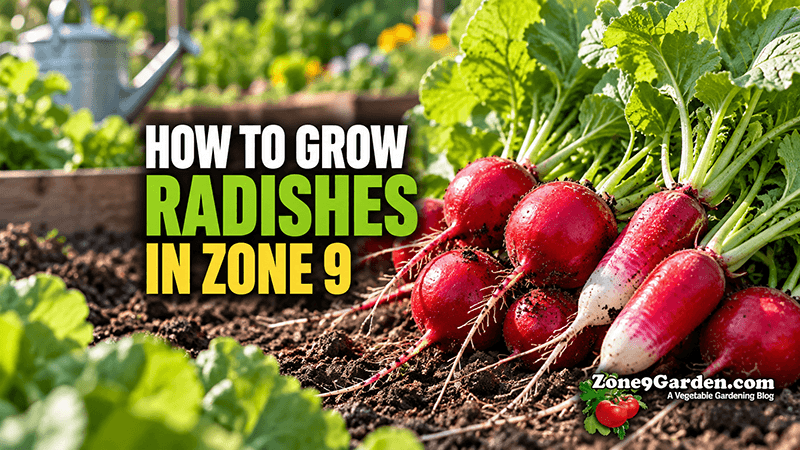
Radishes are one of the fastest and easiest vegetables to grow in a Zone 9 garden. Their short growing season makes them especially useful during fall, winter, and early spring, when cooler temperatures help produce crisp, tender roots with the best flavor.
Unlike warm-season vegetables that require months of care, many standard radishes can go from seed to harvest in only 25–40 days. That makes them an excellent choice for filling gaps between slower-growing vegetables, succession planting, and getting quick harvests from small garden spaces.
Zone 9 also offers a particularly long radish-growing season. Your main challenge isn’t cold—it’s knowing when to stop planting as temperatures rise. Radishes grow best around 50–70°F, while temperatures above roughly 80°F increase the likelihood of bolting, pithy roots, stronger flavor, and poor root development.
For a quick reference to planting dates, varieties, spacing, fertilizer requirements, pests, diseases, and harvest information, see our Zone 9 Vegetable Profile: Radish.
When to Plant Radishes in Zone 9
Radishes are cool-season vegetables, so they should be planted when daytime temperatures are mild rather than during the heat of a Zone 9 summer.
For a standardized Zone 9 schedule, use these windows:
| Planting Stage | Spring | Fall |
|---|---|---|
| Start Indoors | Not recommended | Not recommended |
| Direct Sow | January 1 – March 31 | September 1 – December 31 |
| Transplant | Not recommended | Not recommended |
| Harvest | February 1 – May 1 | October 1 – March 31 |
These are broad Zone 9 planning windows. Your actual planting dates will vary somewhat with your location, weather, and microclimate.
Zone9Garden’s broader seasonal guides also place radishes firmly among the cool-season crops. The Zone 9 Fall Planting Guide includes radishes throughout the fall transition, while the site’s year-round planting calendar includes them among the vegetables that can continue growing during Zone 9’s mild winters.
Direct Sow Radishes
Radishes should generally be direct sown rather than transplanted.
Because you’re harvesting the root, disturbing a young radish during transplanting isn’t particularly useful when the seed germinates quickly and grows readily in the garden.
Sow seeds about ¼–½ inch deep in loose, moist soil.
Standard radishes should eventually have about 1–2 inches between plants. Larger winter and daikon radishes need considerably more room, generally around 4–8 inches.
For traditional garden rows, allow approximately 12–18 inches between rows.
You can find these measurements along with germination temperatures and other quick-reference growing information on the Zone 9 Radish Profile.
Succession Planting Radishes
One of the best ways to grow radishes in Zone 9 is to avoid planting your entire seed packet at once.
Instead, sow a smaller amount every 10–14 days while temperatures remain favorable.
For example, you might plant one short row in early October, another two weeks later, and another two weeks after that. Instead of having dozens of radishes ready simultaneously, you’ll have a steady supply reaching harvest size.
This is exactly the strategy described in our Succession Planting in Zone 9 guide: smaller radish plantings every 10–14 days can spread the harvest instead of producing one large crop all at once.
Continue succession planting through the cool season, but stop as consistently hot weather approaches.
Best Radish Varieties for Zone 9
There are dozens of radish varieties, ranging from small round red radishes to long white Asian types.
Several are particularly useful choices based on recommendations represented in the Zone9Garden radish database.
Cherry Belle is a fast-maturing round red radish recommended by UF/IFAS and UC ANR. It’s an excellent choice if you want a traditional garden radish.
White Icicle produces long white roots rather than round red ones. UF/IFAS and Texas A&M recommend it for cool-season gardens.
Sparkler produces attractive red-and-white globe-shaped roots and appears in recommendations from UF/IFAS and Arizona Extension.
Champion is another dependable round red variety recommended by UF/IFAS, Texas A&M, and Arizona Extension.
Easter Egg produces roots in several colors and is recommended by UC ANR and Arizona Extension.
French Breakfast produces elongated red roots with white tips and works well as a quick spring or fall radish.
April Cross is a larger winter or Asian-type radish recommended by UC ANR.
Daikon produces large, elongated white roots. UF/IFAS recommends daikon, although these larger radishes take considerably longer to mature than small spring types.
Preparing the Soil
Good soil preparation makes a noticeable difference with radishes.
The ideal soil is loose, deep, well-drained sandy loam or loam with plenty of organic matter.
Remove rocks, large clods, and other obstructions from the planting area. Anything that interferes with the expanding root can contribute to misshapen radishes.
Avoid waterlogged soil as well.
A soil pH around 6.0–6.5 is a good target.
Before planting, work finished compost or other organic matter into the bed if needed. A soil test is the best way to determine whether additional fertilizer is necessary.
How Much Sun Do Radishes Need?
Grow radishes in full sun, preferably somewhere receiving at least six hours of direct sunlight each day.
They can tolerate light partial shade, particularly during the warmer edges of the growing season.
However, don’t use shade as a substitute for planting during the appropriate season. Once Zone 9 temperatures become consistently hot, radish quality typically declines regardless of where they’re planted.
Radish Germination
Radish seeds germinate quickly.
Under favorable conditions, expect seedlings to emerge in approximately 3–7 days.
The preferred germination range is approximately 55–85°F, with 70–77°F providing an excellent target.
About 40°F is a practical lower soil-temperature threshold, although germination will be much slower in cold soil.
For overall root development rather than germination alone, cooler conditions around 50–70°F are preferable.
Keep the seedbed consistently moist while you’re waiting for seedlings to emerge. Tiny radish seeds are planted shallowly, so allowing the soil surface to dry repeatedly can interfere with germination.
Thin Radish Seedlings Early
Overcrowding is one of the easiest radish-growing problems to prevent.
Radishes germinate readily, which makes it tempting to leave all the seedlings growing together.
Don’t.
For standard varieties, thin seedlings until they’re approximately 1–2 inches apart.
Large winter and daikon varieties generally need about 4–8 inches.
Proper spacing gives each root room to expand and reduces competition for water and nutrients.
If you’re growing radishes primarily for their roots, thinning is much better than allowing a crowded row to remain untouched.
Watering Radishes
Consistent moisture is critical for good radishes.
Keep the soil evenly moist throughout germination and root development.
You don’t want saturated soil, but you also don’t want the bed cycling repeatedly between very dry and very wet conditions.
Irregular watering can contribute to:
- Cracked roots
- Poor texture
- Stronger flavor
- Tough roots
- Uneven growth
This is especially important because radishes develop so quickly. A relatively short period of drought can affect a significant portion of their entire growing cycle.
Fertilizing Radishes
Radishes are light-to-moderate feeders and don’t need aggressive fertilization.
In fact, excessive nitrogen can work against you by encouraging lots of leafy growth without corresponding root development.
Before planting, incorporate finished compost and apply fertilizer according to your soil-test results. If your soil needs additional fertility, a modest balanced fertilizer can be incorporated before sowing.
Once plants reach approximately 3–4 inches tall, a light nitrogen side-dressing can be used if fertility is low or the plants appear pale.
During root development, concentrate more on maintaining even moisture than continuously applying fertilizer.
Fast-growing spring radishes generally don’t need another fertilizer application in well-prepared soil.
Longer-season winter and daikon radishes may benefit from a light supplemental feeding when they’re growing in very sandy soil, nutrients have been leached by heavy rain, or plant growth indicates a deficiency.
Growing Radishes in Containers
Radishes are excellent container vegetables because most standard varieties have relatively small root systems and mature quickly.
The most important consideration is container depth.
Small round radishes don’t require an exceptionally deep container, but elongated varieties need enough loose soil for their roots to develop without obstruction. Large daikon types require considerably more depth than Cherry Belle or similar globe radishes.
Regardless of variety, use a container with drainage holes and a loose, well-draining growing medium.
Container soil can dry faster than an in-ground garden, so check moisture regularly.
Growing Radishes During a Zone 9 Winter
Winter is one of the advantages Zone 9 gardeners have with radishes.
Established plants tolerate light frost, and temperatures around 32°F aren’t automatically a problem.
Significant freeze injury becomes more likely below approximately 25°F, particularly with young plants or exposed roots.
For much of Zone 9, however, the bigger seasonal limitation is eventually heat rather than winter cold. Zone9Garden’s winter planting guide specifically includes radishes among the vegetables suited to the Zone 9 winter garden.
This gives gardeners an opportunity to grow successive crops throughout much of fall and winter.
What Happens When the Weather Gets Hot?
Radishes tell you quickly when they aren’t happy with the weather.
Once temperatures climb above approximately 80°F, you’re more likely to encounter:
- Bolting
- Pithy roots
- Root deformation
- Tough texture
- Stronger or excessively pungent flavor
Hot, dry conditions make these problems even more likely.
Rather than trying to force standard radishes through Zone 9 summer heat, concentrate production during fall, winter, and early spring.
Common Radish Pests
Radishes grow quickly enough to escape some pest problems, but several insects can still cause trouble.
Flea Beetles
Flea beetles are most troublesome on seedlings and young plants during fall through spring.
The adults chew numerous tiny holes in the foliage, creating a distinctive “shot-hole” appearance. Heavy infestations can stunt young plants and reduce the leaf area available to support rapid root growth.
Cabbage Maggots
Cabbage maggots are particularly associated with cool, wet conditions.
The white larvae tunnel directly into radish roots, leaving scars and channels. Damage can also cause yellowing, poor growth, and entry points for secondary decay.
Severe infestations can ruin the roots entirely.
Harlequin Bugs
Harlequin bugs become more common as temperatures warm.
Adults and nymphs suck sap from the leaves, producing pale stippling and yellow or white blotches. Heavy infestations can distort foliage, cause wilting, and stunt plants.
Bagrada Bugs
These insects are most likely during warm periods, particularly late summer and fall.
Feeding creates characteristic pale or white marks on young foliage. Seedlings may become distorted or stunted, and severe infestations can kill very young plants.
Cucumber Beetles
Adults chew holes in foliage and flowers.
Established radishes may tolerate limited damage, but significant feeding on seedlings can reduce plant vigor and delay root development.
Common Radish Diseases
Cool-season growing doesn’t eliminate disease problems. Moisture, humidity, and temperature all influence which diseases become troublesome.
Downy Mildew
Cool, humid, or wet weather favors downy mildew.
Look for pale yellow or angular areas on the upper surfaces of leaves and grayish-white to purple growth underneath. Severe infections can cause browning, distorted foliage, and leaf loss.
Black Rot
Black rot is favored by warm, wet, humid conditions.
Yellow V-shaped lesions can develop from the leaf margins toward the veins. As infection progresses, leaves can become badly damaged and plants may become stunted.
Bacterial Root Rot and Soft Rot
Warm, wet conditions can encourage bacterial root problems.
Affected roots become soft or discolored and can develop internal deterioration or cavities. UF/IFAS has documented bacterial root rot in daikon radishes.
Radish Scab
Radish scab produces corky or scabby lesions on the root.
Warm soils and irregular moisture can increase the problem. Keeping soil moisture consistent can help reduce disease severity.
Mosaic Virus
Mosaic diseases can appear when insect vectors such as aphids are active.
Symptoms include mottled foliage, yellowing between the veins, distorted young leaves, and reduced plant vigor. Severe infection can ultimately reduce root development.
When to Harvest Radishes
Don’t leave standard radishes in the ground simply because they still look healthy.
For most standard varieties, expect approximately 25–40 days from seed to harvest, with around 30 days being a useful average.
Winter and daikon varieties typically require around 50–60 days, and some cultivars take longer.
Your spring Zone 9 harvest window generally runs from approximately February 1 through May 1.
Fall and winter crops can generally be harvested from approximately October 1 through March 31.
Those dates overlap because Zone 9 allows radishes to be grown through much of the cool season.
How to Tell When Radishes Are Ready
Check the top of the root where it meets the soil.
Radishes are ready when they’ve reached the expected size for the cultivar and the shoulders are becoming visible near the soil surface.
The root should still feel:
- Firm
- Crisp
- Tender
Don’t judge every variety by the same diameter. A Cherry Belle and a daikon have very different mature sizes.
The important thing is to harvest each variety when it reaches its expected usable size.
Overmature radishes can become pithy, woody, cracked, fibrous, and increasingly pungent.
How to Harvest Radishes
Harvesting standard radishes is simple.
Grasp the foliage near the base and gently pull the entire plant from the ground. If your soil has become firm or you’re harvesting a long-rooted variety, loosen the soil first so you don’t break the root.
Remove the leafy tops before storing the roots and refrigerate the radishes promptly.
Standard radishes may be ready only three to six weeks after sowing, which is one reason they’re such a rewarding crop for beginning gardeners and experienced growers alike.
Crop Rotation and Companion Plants
Radishes belong to the Brassicaceae family, along with cabbage, broccoli, cauliflower, kale, and collard greens.
Those relationships matter when planning crop rotation.
Avoid repeatedly planting radishes in the same bed immediately before or after other Brassicaceae crops. Rotating to unrelated plant families can help interrupt pest and disease cycles associated with brassicas.
Potential insectary plants included in the Zone9Garden radish database are:
- Sweet alyssum
- Dill
- Cilantro
- Calendula
- Marigolds
For crop-rotation purposes, avoid following radishes repeatedly with:
- Broccoli
- Cabbage
- Cauliflower
- Kale
- Collard greens
The Key to Growing Great Radishes in Zone 9
Radishes don’t need a complicated growing system.
They need the right season, loose soil, enough room, and consistent moisture.
Direct sow them during Zone 9’s cooler months, thin seedlings early, keep the soil evenly moist, avoid excessive nitrogen, and harvest promptly.
Most importantly, take advantage of how quickly radishes grow. Instead of treating them as a one-time crop, plant another small batch every 10–14 days while temperatures remain cool.
With that approach, a small patch of garden can produce fresh radishes repeatedly throughout much of the Zone 9 fall, winter, and early-spring growing season.
For the planting dates, varieties, spacing, fertilizer schedule, pest and disease information, and harvest data in one place, bookmark the Zone 9 Vegetable Profile: Radish.
More Zone 9 Radish & Planting Resources
- Zone 9 Vegetable Profile: Radish — Quick-reference radish planting, growing, pest, disease, and harvest information.
- Succession Planting in Zone 9: Keep Your Garden Producing All Season — Use repeated radish sowings every 10–14 days to extend your harvest.
- Zone 9 Fall Planting Guide — See where radishes fit into the fall and winter vegetable garden.
- Zone 9 Planting Calendar: What to Plant Every Month — Plan radishes and other vegetables throughout the Zone 9 gardening year.
- What to Plant in September in Zone 9 — Includes radishes as a fast-growing option for beginning the Zone 9 fall garden.